
An elastic, clasp and wrap jade bracelet may all be listed for the same 15–17 cm wrist, yet feel nothing alike once you live with them. The closure decides how quickly the bracelet goes on, whether you can adjust it during the day, where pressure sits, and which part will eventually need repair.
- Choose elastic for the fastest, simplest on-and-off routine.
- Choose a clasp with an extension chain when you want the most precise fit and a more finished jewelry look.
- Choose a wrap when you want several visible layers from one piece and do not mind taking longer to arrange it.
There is no universally “best” construction. A small elastic strand suits someone who gets dressed in a hurry. A spring-ring clasp suits someone who notices a few millimeters of looseness. A multi-wrap design suits someone who wants the bracelet to be the outfit’s focal point. The right choice is the one whose daily inconveniences you barely notice.
Elastic vs clasp vs wrap: the practical comparison
| Question | Elastic | Clasp + extension | Wrap |
|---|---|---|---|
| Fastest to put on? | Yes Roll over the hand | Usually needs two hands | Slowest; wind and arrange layers |
| Fine adjustment? | No; the finished loop sets the fit | Best Choose a chain link | Depends on cord length and closure |
| Feel on the wrist | Even circle; beads may rotate | Controlled drape; chain can hang | Broad, layered coverage |
| Main wear point | Elastic between beads | Clasp, jump rings and plating | Cord junctions and charm loops |
| Good for limited dexterity? | Often easiest, if it clears the hand | Small spring ring can be difficult | Usually requires the most handling |
| Best visual effect | Clean, uninterrupted bead circle | Fine-jewelry finish and charms | Layered statement look |
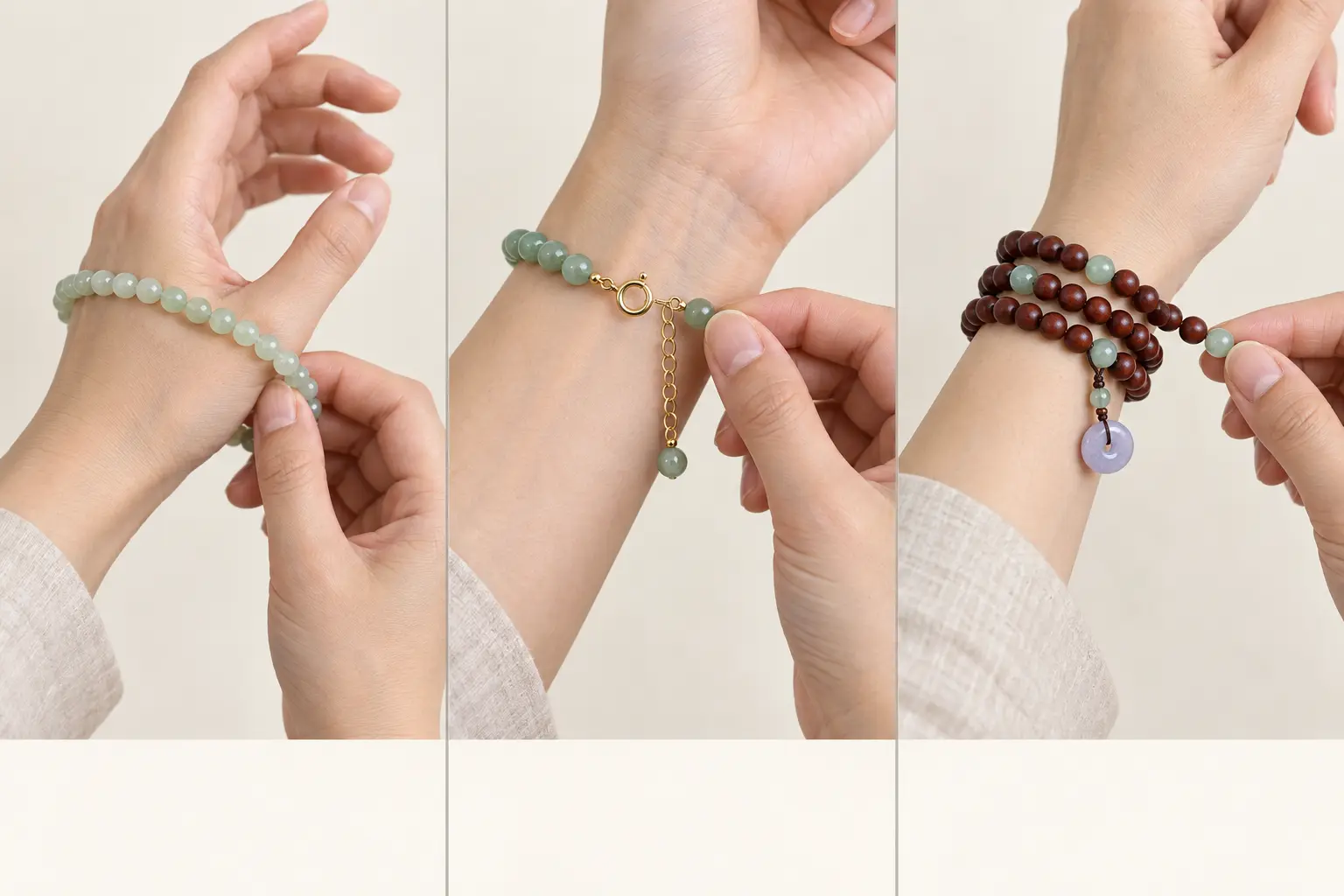
The wearing method is part of the purchase decision. If a fastening routine annoys you in the morning, the bracelet will spend more time in its box.
Elastic bracelets: quickest to wear, least adjustable
An elastic jade bracelet is a continuous loop. There is no clasp to find and no loose end to manage: you roll it over the hand, settle it around the wrist and leave. That simplicity is why elastic works so well for a first bead bracelet, a busy morning routine or a wearer who struggles with tiny hardware.
The trade-off is fixed circumference. Elastic stretches during entry, but it is not a fit adjustment system. If the finished bracelet is too loose, it will slide and strike desks; if it is too tight, the beads can leave marks and the cord remains under constant tension. Confirm the actual wrist range and use our jade bracelet size guide before ordering.
How to put one on without shortening its life
- Place the fingers together so the hand is as narrow as it can comfortably be.
- Move a few beads over the knuckles at a time while supporting the rest of the loop.
- Roll the final section over the thumb joint; do not hook one bead and pull.
- To remove it, reverse the same gradual motion rather than stretching the bracelet into an oval.
Small beads generally pass over the hand more smoothly and sit closer to the wrist. Larger beads require a slightly wider loop for the same inner wearing space, project farther from the skin and make the strand more noticeable during typing. Weight matters too: compare an 8.50 g strand of 5 mm beads with a 34.92 g strand built around 9 × 10 mm beads. Both can fit 15–17 cm wrists, but nobody would mistake one wearing experience for the other.
Clasp bracelets: the most precise fit
A spring-ring or lobster clasp opens the bracelet completely, so the piece does not need to stretch over the hand. When it is paired with an extension chain, the wearer can change the working length link by link. This is the strongest option for someone who wants a closer fit one day and a slightly looser fit over a sleeve the next.
“Adjustable” still has limits. A bracelet listed for 15–17 cm wrists offers about 2 cm of stated range; it is not a universal fit. The usable range also depends on where the clasp can securely attach. For a gift, an extension chain gives more tolerance than fixed elastic, but you should still estimate the recipient’s wrist rather than guessing.
What a clasp asks from the wearer
Small spring rings look neat and add little bulk, but they require fingernail pressure and coordination. Someone with arthritis, reduced grip or long nails may find a tiny clasp frustrating even if the finished bracelet fits perfectly. A magnetic closure or larger lobster clasp can be easier, but those are different products with their own security and size considerations.
Before wearing, tug lightly at the closed clasp and inspect the small jump rings connecting it to the strand. A spring ring should close completely without a visible gate gap. A round connecting ring should not show an open seam. With gold-plated S925 hardware, keep perfume, sanitizer, lotion and water away from the metal as much as practical; repeated exposure changes the finish long before it changes the jade.
Wrap bracelets: a layered look with more handling
A wrap bracelet turns one long strand into two, three or more visible circuits. It covers more wrist area than a single elastic loop and can mix bead sizes, wood, cord, jade and a hanging peace buckle without looking crowded. That visual complexity is its reason to exist—and also the source of its extra upkeep.
Wrap fit depends on more than wrist circumference. Total strand length, bead diameter, number of circuits, cord thickness, closure style and the position of the focal charm all matter. Distribute the layers rather than stacking them tightly in one spot. The bracelet should feel secure, but you should still be able to move a fingertip under a layer without forcing it.
A multi-wrap design is usually the slowest of the three to put on one-handed. It also has more opportunities to twist around itself in storage. Lay it flat or coil it loosely in a fabric-lined compartment, and never lift the whole bracelet by its charm. If the design contains wood, follow the wood’s care limits: keep the complete bracelet dry even though clean water alone would not normally harm untreated jade.
Which construction fits your routine?
If daily wear is your priority, read when to remove a jade bracelet for showering, sleep, the gym and swimming. Closure choice changes convenience, but it does not turn jewelry into protective equipment.
Six real bracelets that fit the same range—but not the same person
Every example below is listed for a 15–17 cm wrist. The differences in closure, bead size, weight and materials show why a wrist range by itself cannot predict comfort.
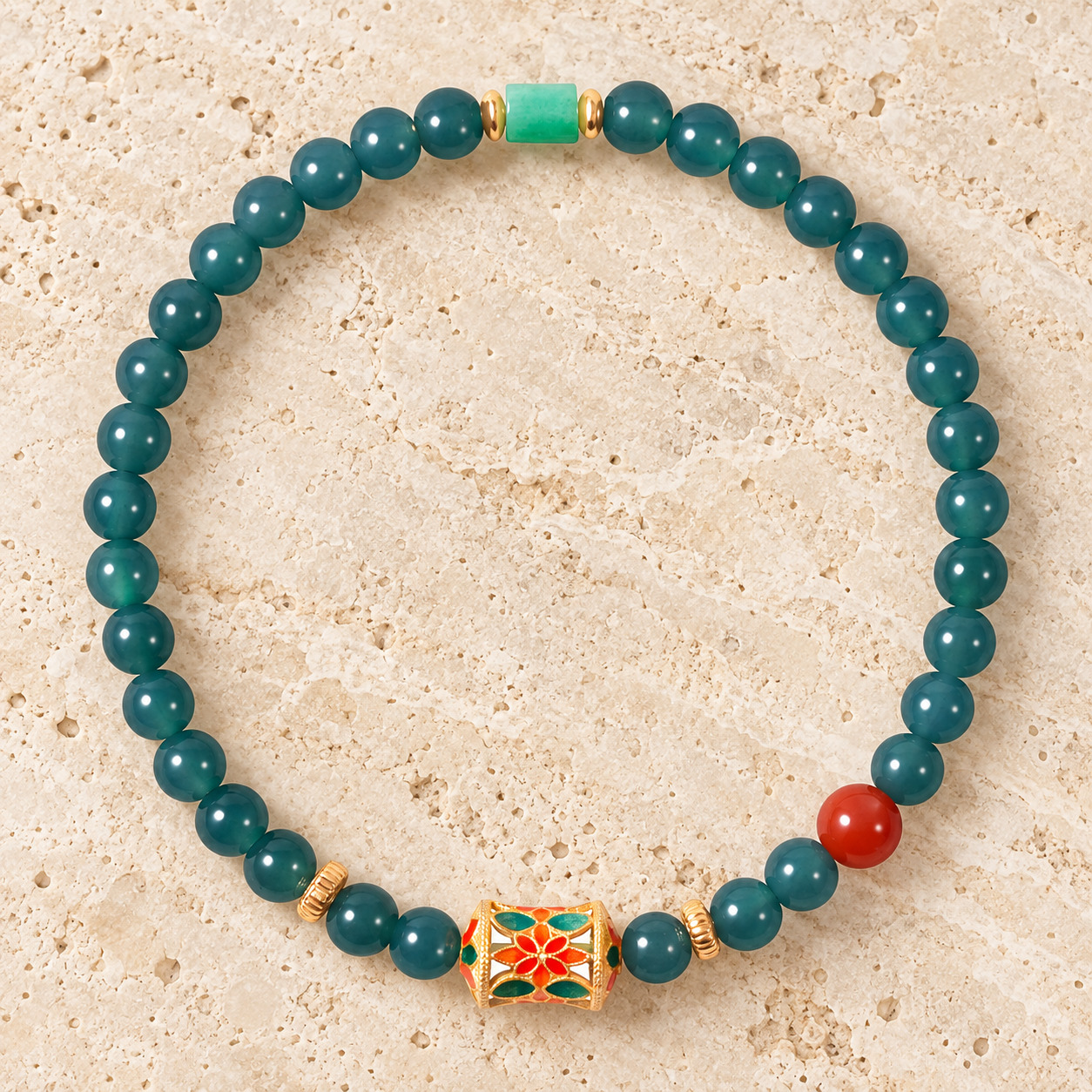
Blue Water Jadeite Bracelet
The lightest, lowest-profile option here. The 5 mm beads and 8.50 g finished weight make it the easiest elastic example for typing and ordinary daytime movement. It has no micro-adjustment: the finished loop either suits the wrist or it does not.
Elastic · 5 mm jadeite · 8.50 g · 15–17 cm wrist fit
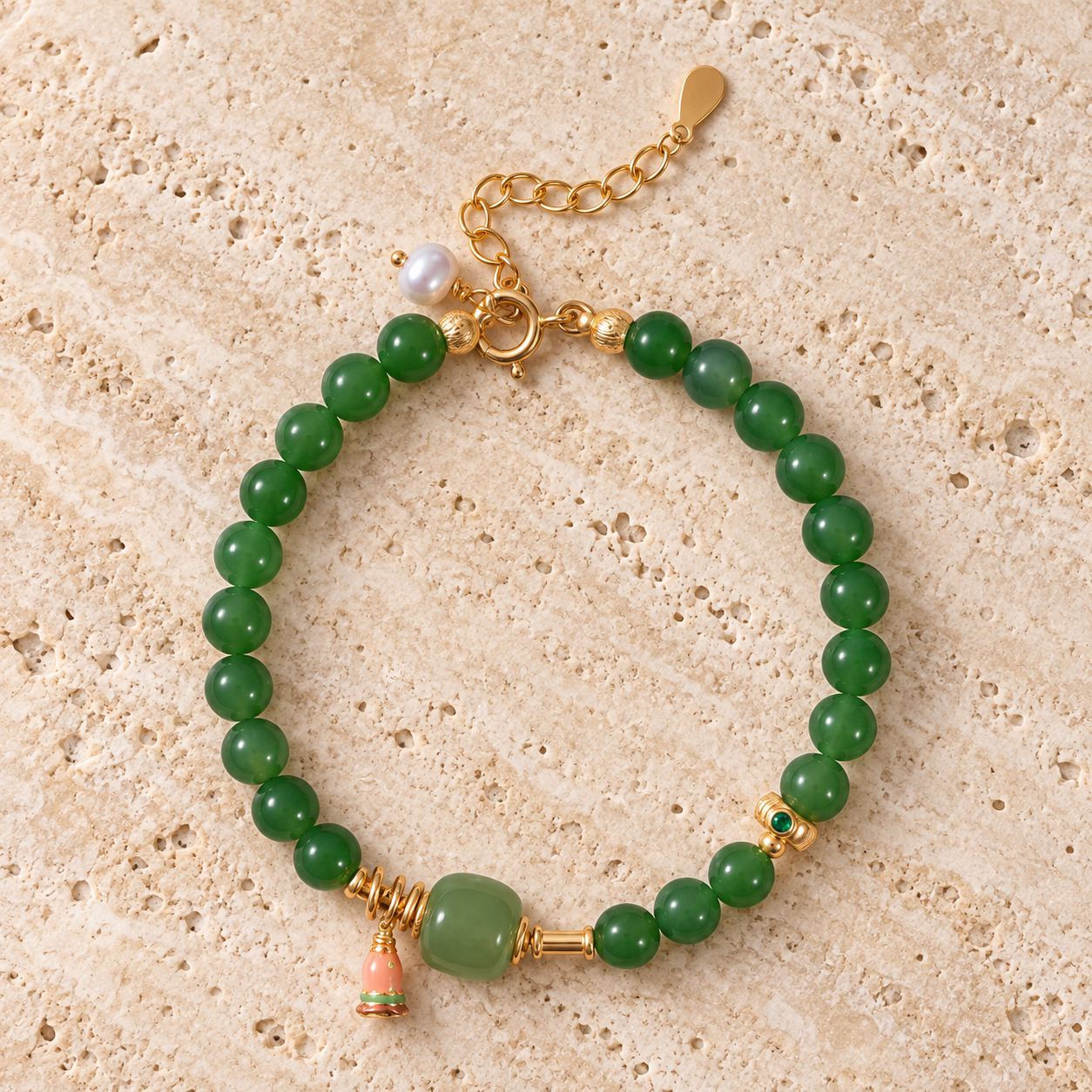
Green Hetian Jade Bracelet
A 6 mm bead strand with a spring-ring clasp and extension chain. It offers the most controlled fit in this group, while the enamel, pearl, zircon and gold-plated S925 details make the hardware worth checking before wear.
Clasp + extension · 6 mm jade · 13 g · 15–17 cm wrist fit
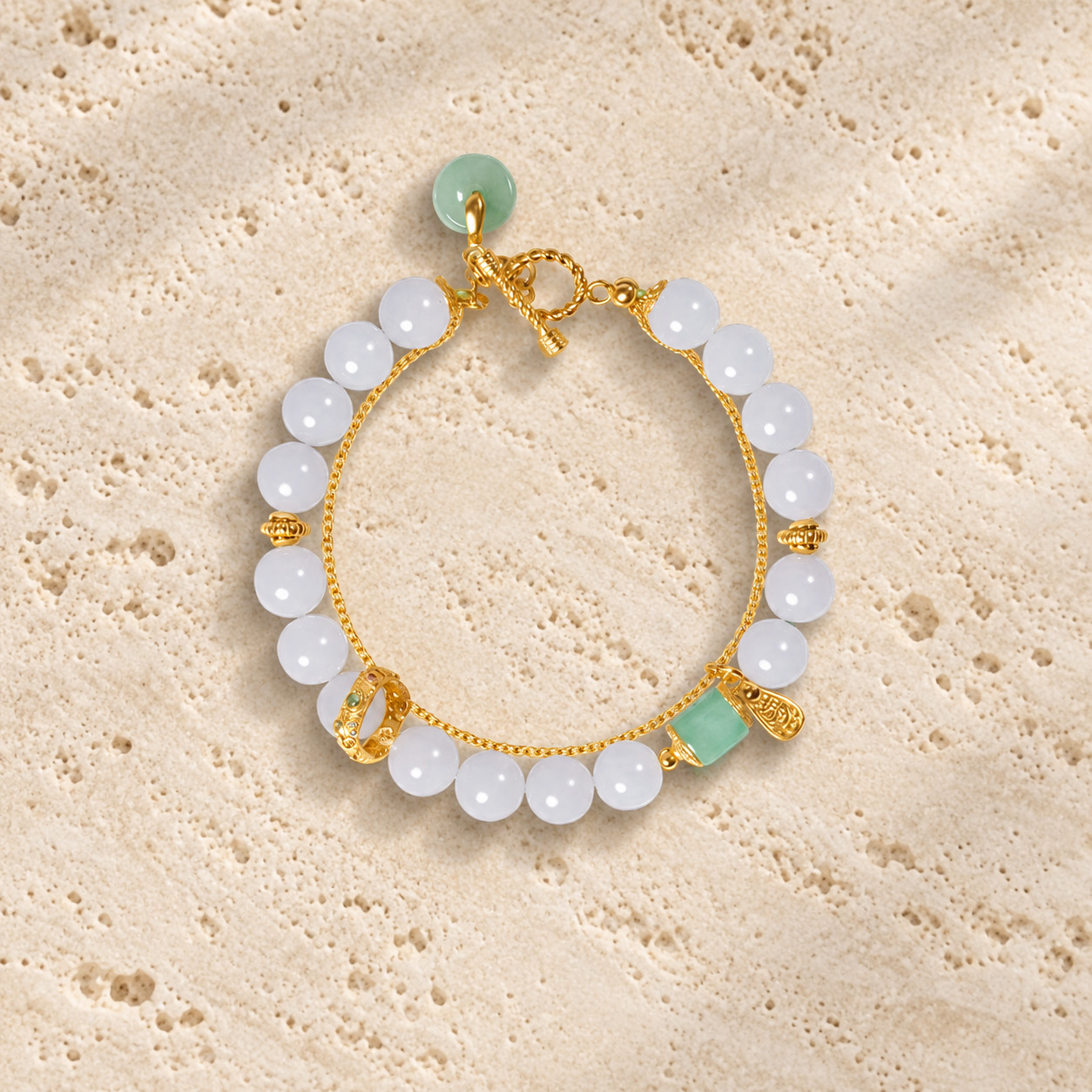
Lavender Jade Double-Layer Bracelet
The bead-and-chain construction creates movement without requiring a full multi-wrap strand. At 20 g it feels more present than the two smaller examples, and its second layer needs a moment of arranging after the clasp is closed.
Double-layer clasp · 8 mm jade · 20 g · 15–17 cm wrist fit
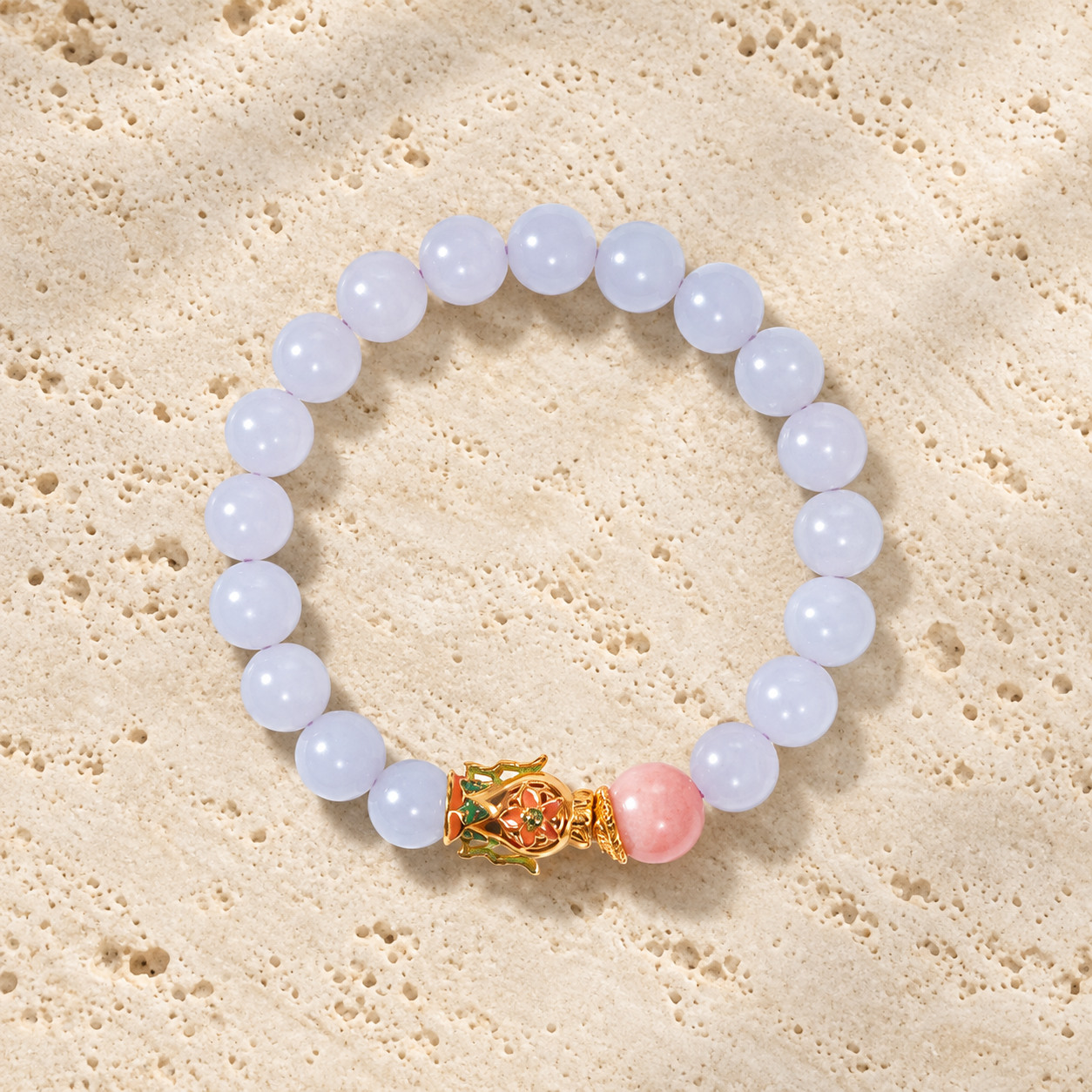
Lavender Jade and Rhodochrosite Bracelet
The 10 mm beads make this elastic piece simple to fasten but visually substantial. Its 28 g weight and larger bead profile will be noticeable at a desk; roll it over the hand rather than pulling the floral centerpiece.
Elastic · 10 mm jade and rhodochrosite · 28 g · 15–17 cm wrist fit
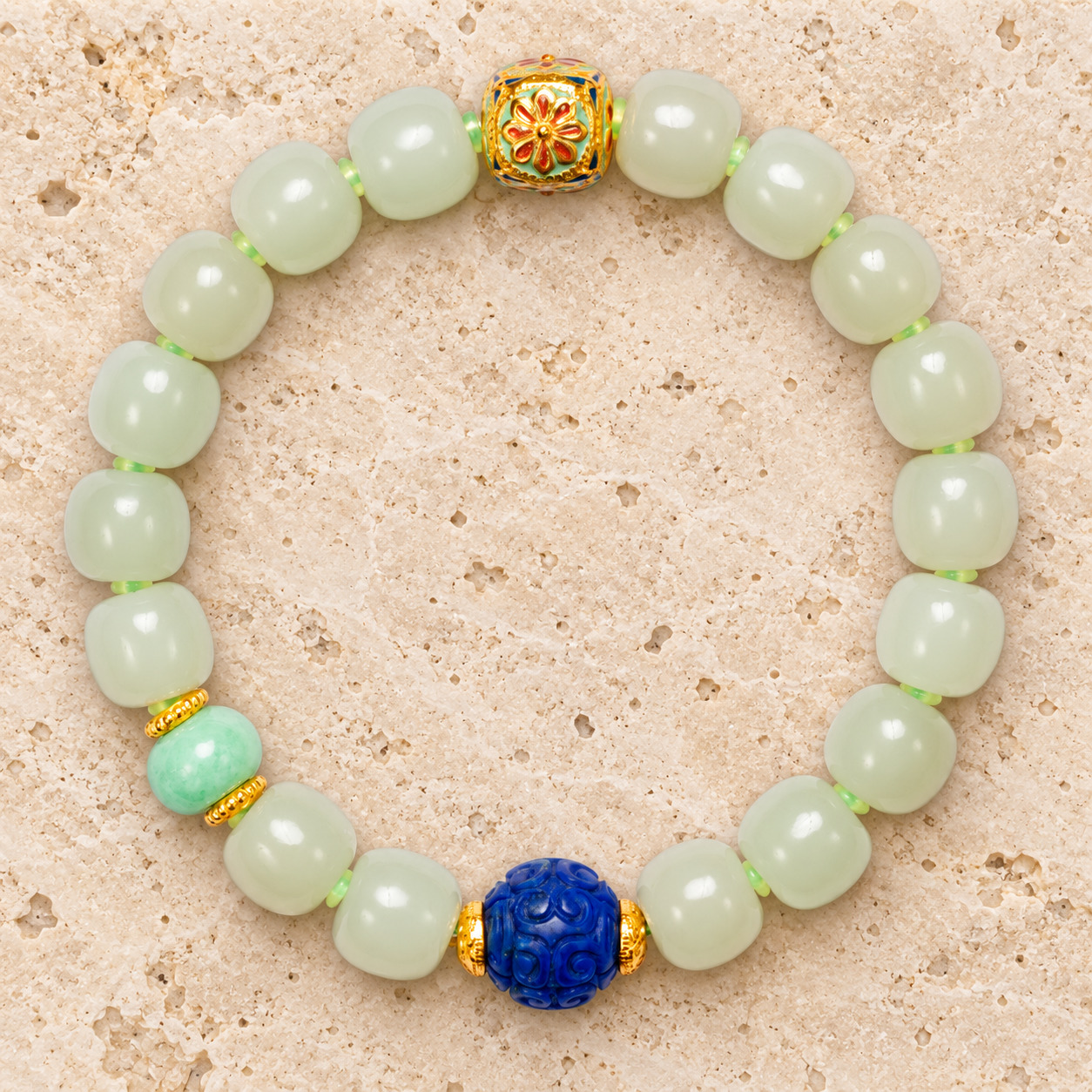
Hetian Jade, Lapis and Enamel Bracelet
This is the heaviest elastic example at 34.92 g. The 9 × 10 mm old-style jade beads and 11 mm lapis focal bead give the clean convenience of elastic with the feel of a statement bracelet.
Elastic · 9 × 10 mm jade · 34.92 g · 15–17 cm wrist fit
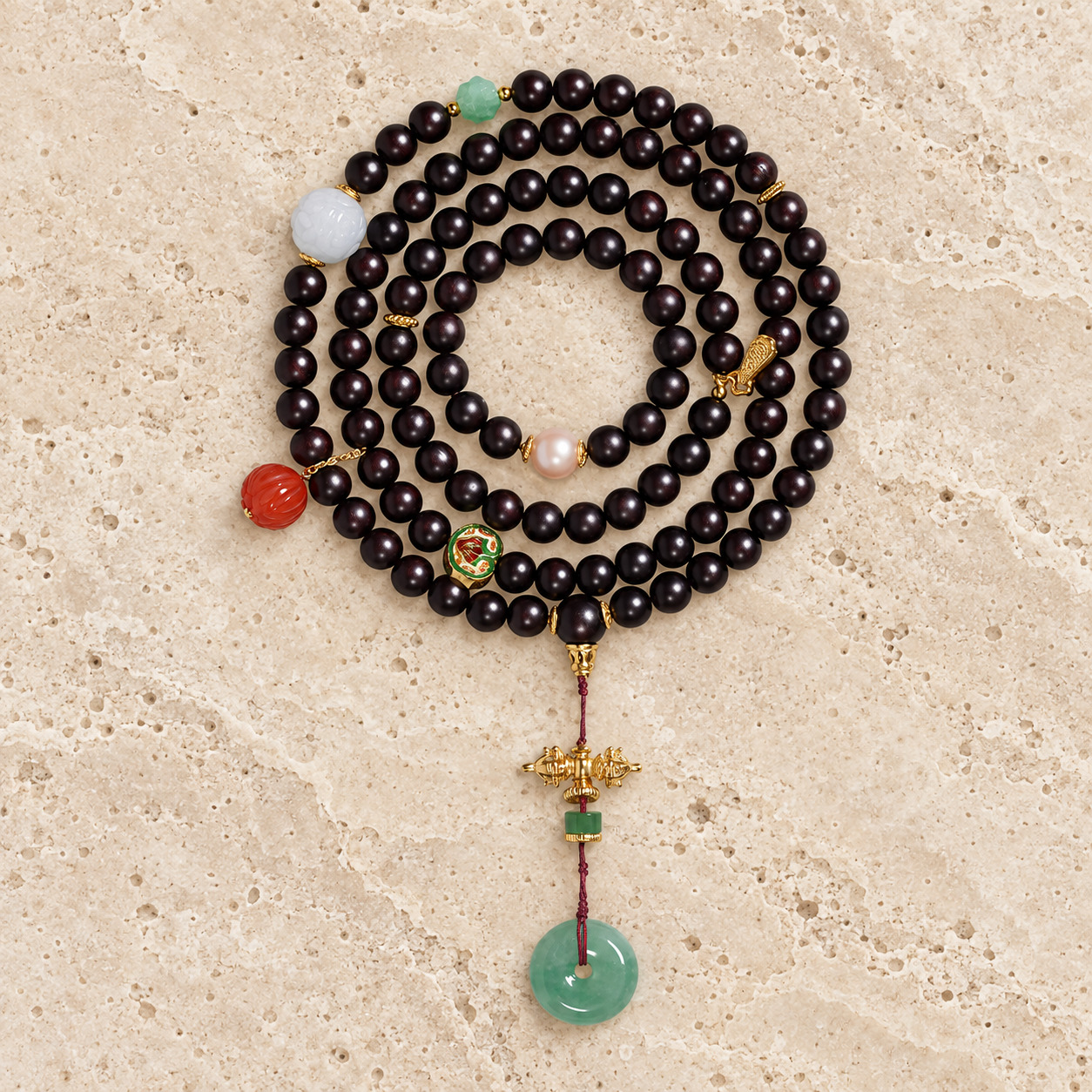
Red Sandalwood Jade Wrap Bracelet
Three visual layers, 7 mm wood beads and a 17 mm jade peace buckle make this the most involved piece to arrange. Its 33 g total weight is spread across a broad area, while the braided cord and wood set a keep-dry care rule.
Multi-wrap · 7 mm sandalwood · 33 g · 15–17 cm wrist fit
The choice between jadeite and nephrite still affects color, texture and design, but closure and finished weight usually have the more immediate effect on how a bracelet behaves on your wrist.
Check the part most likely to fail
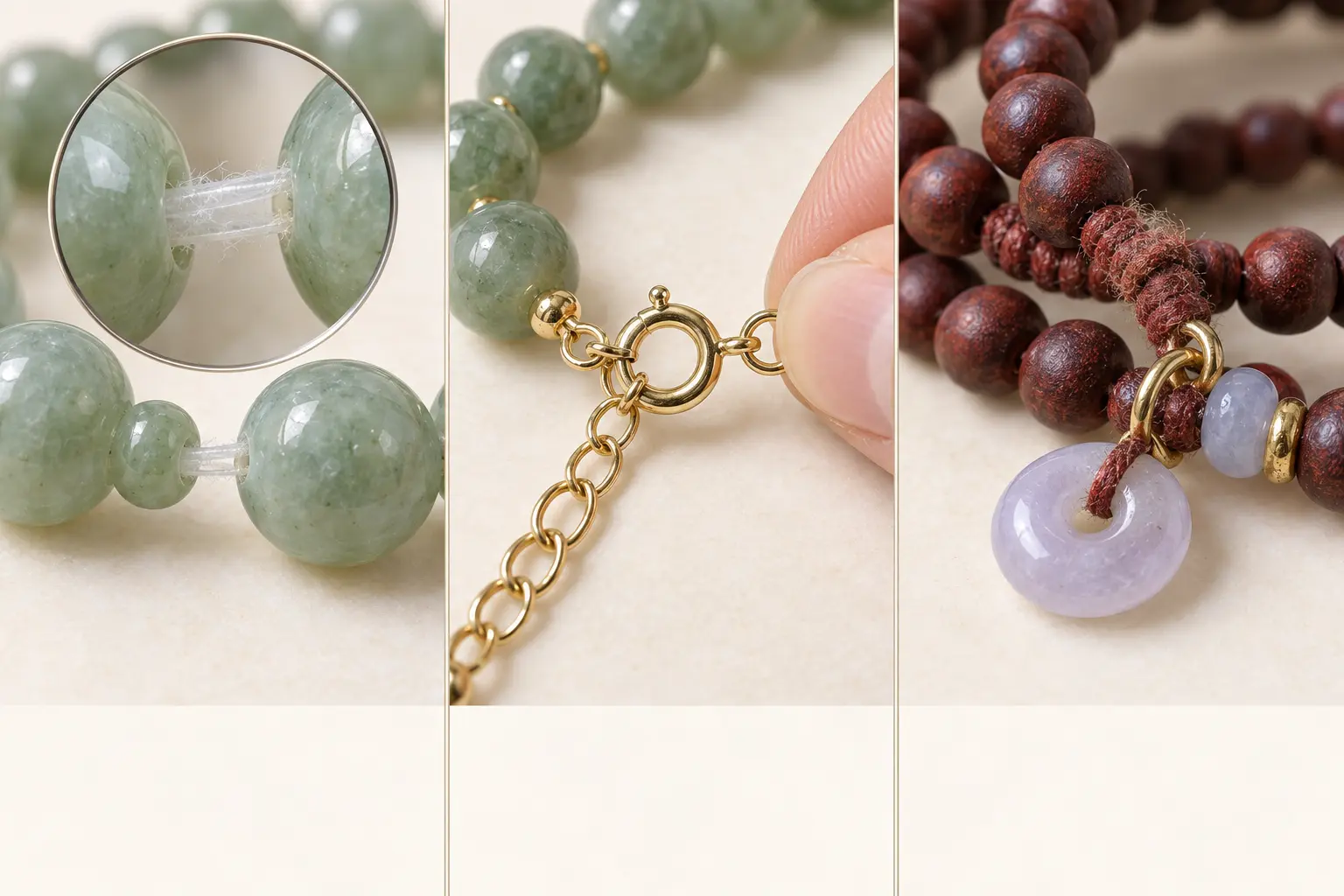
A 30-second inspection catches most preventable strand failures. Check in bright, indirect light and stop wearing the bracelet when a structural part looks different from when it was new.
Elastic inspection
Gently move neighboring beads apart just far enough to see the exposed cord. Do not repeatedly stretch the whole loop as a “test”—that test itself adds fatigue. If fibers, cracks or permanent elongation are visible, place the bracelet flat in a pouch until it can be restrung.
Clasp inspection
Open and release the clasp once. The gate should return all the way to its closed position. Then examine each connecting ring from the side; the two cut ends should meet rather than forming a hook-shaped gap. If a charm or chain link is distorted, have it repaired before wearing the bracelet outside.
Wrap inspection
Follow the cord through each junction and around the focal charm. Pay special attention where flexible cord meets a rigid metal loop, because that point bends during every wrap. Surface fuzz is an early warning; a thin, hard or partially cut section is a stop-wearing sign.
The honest recommendation
For the broadest everyday convenience, start with a light elastic bracelet in the correct size. For the most exact wrist fit, choose a clasp and extension chain. Choose a wrap because you genuinely enjoy its layered appearance—not because it sounds more adjustable. Some wraps adjust; others simply redistribute a fixed length into several circuits.
Then look past the closure. Check bead diameter, finished weight, hanging charms and mixed materials. A 5 mm, 8.50 g elastic bracelet and a 10 mm, 28 g elastic bracelet share a fastening method but solve different style and comfort needs. Construction narrows the choice; the full specification finishes it.
Frequently asked questions
Is an elastic or clasp bracelet better?
Elastic is quicker and usually easier to put on, while a clasp with an extension chain offers more precise adjustment. Choose elastic for convenience and a clasp when exact fit and a fine-jewelry finish matter more than speed.
How tight should an elastic jade bracelet be?
It should stay near the wrist without pinching, leaving deep marks or keeping the elastic visibly stretched. You should be able to move a fingertip under the strand with light pressure. Use the seller’s stated wrist range rather than relying on stretch.
Which bracelet is easiest to put on with one hand?
A correctly sized elastic bracelet is generally easiest because it rolls over the hand without a fastening step. Small spring-ring clasps usually need the most finger coordination; a wrap also takes time to wind and arrange.
Is an adjustable jade bracelet a safer gift?
An extension chain provides more fit tolerance than a fixed elastic loop, but it is not one-size-fits-all. Confirm the bracelet’s stated wrist range and estimate the recipient’s wrist before ordering.
How should a wrap bracelet fit?
The layers should sit securely without cutting into the skin. They may move slightly, but should not stack into a tight ridge or slide over the hand. Fit depends on total strand length, bead size, number of wraps and closure position.
Which type lasts longest?
No closure has a guaranteed lifespan. Elastic is designed to be restrung periodically; clasp bracelets need hardware inspections; wrap bracelets need cord checks. Care, frequency of wear, weight and construction quality matter more than the category name.
Can an elastic jade bracelet be restrung?
Usually yes. Restring it before the cord snaps so the original bead order and components can be preserved. A jeweler should also check bead holes for sharp edges that could cut the replacement cord.
Can I sleep or shower in any of these bracelets?
Remove all three for showers, swimming, workouts and sleep. Water, soap, pressure and snagging add unnecessary wear to elastic, metal hardware, cord, plating and mixed materials.
How this comparison was made: Recommendations are based on the wearing mechanics of the three constructions and the published wrist range, bead dimensions, materials and finished weights of the six LuckJade examples above. Fit remains personal; measurements describe a starting range, not a guarantee of comfort.
Filter your shortlist by how you want to put the bracelet on, adjust it and maintain it.
Compare the three constructions