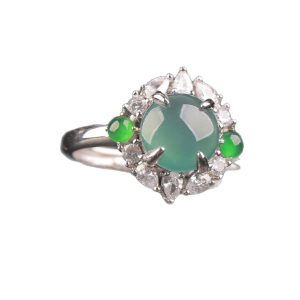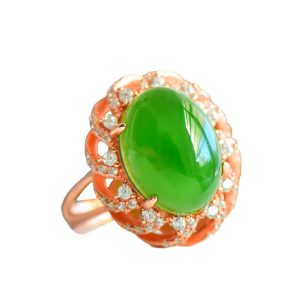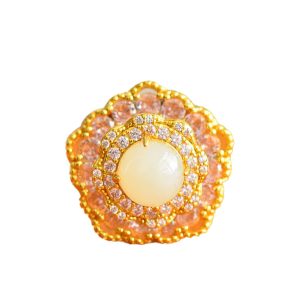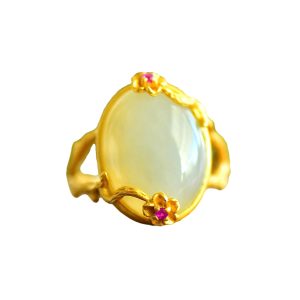
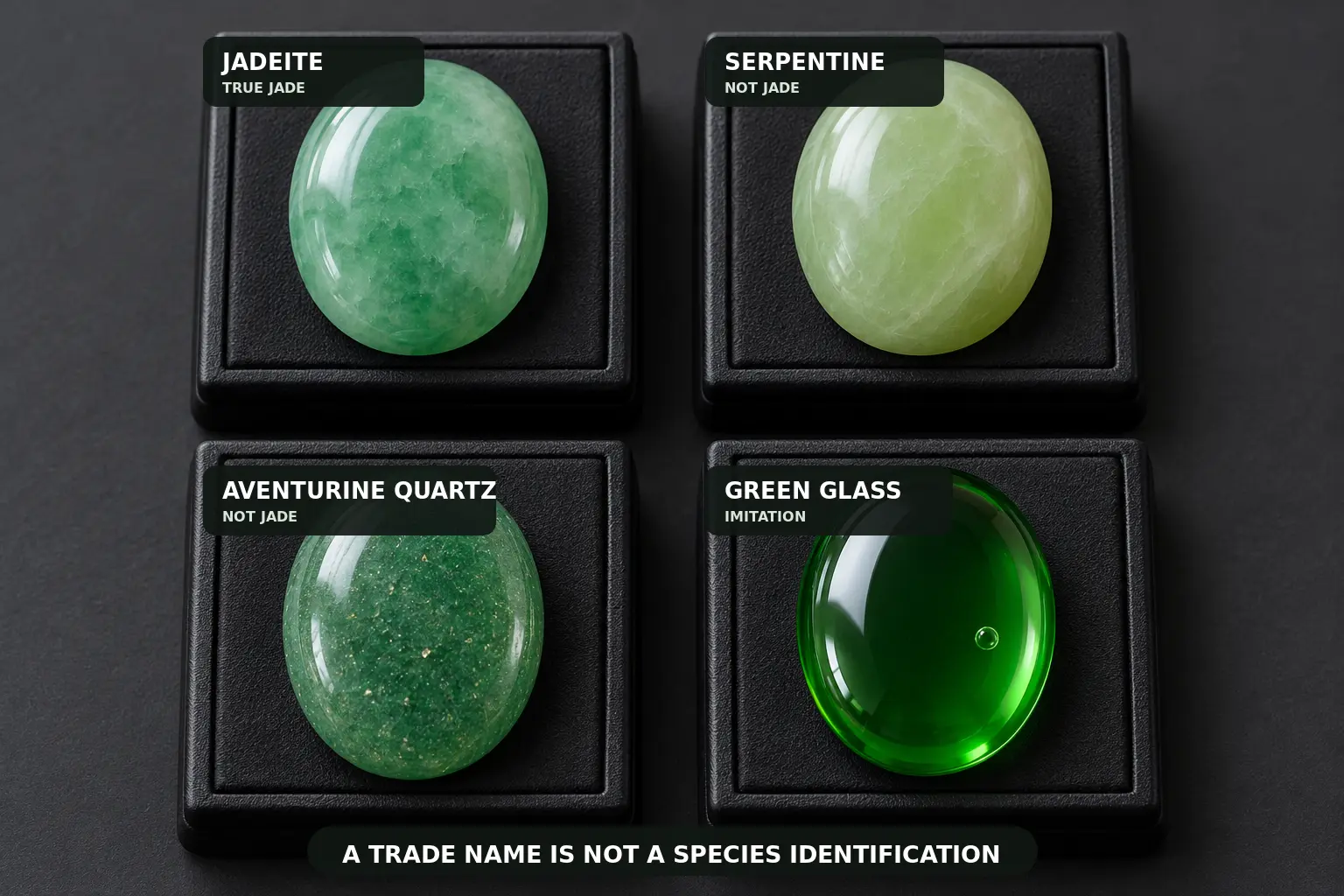
“Jade ring” sounds like one material, but the label can hide several very different stones. Genuine jade usually means jadeite or nephrite; some gemological reports also use jade for certain green omphacite. Serpentine, aventurine quartz and green glass may resemble jade, yet they are different materials and should be sold under their own names.
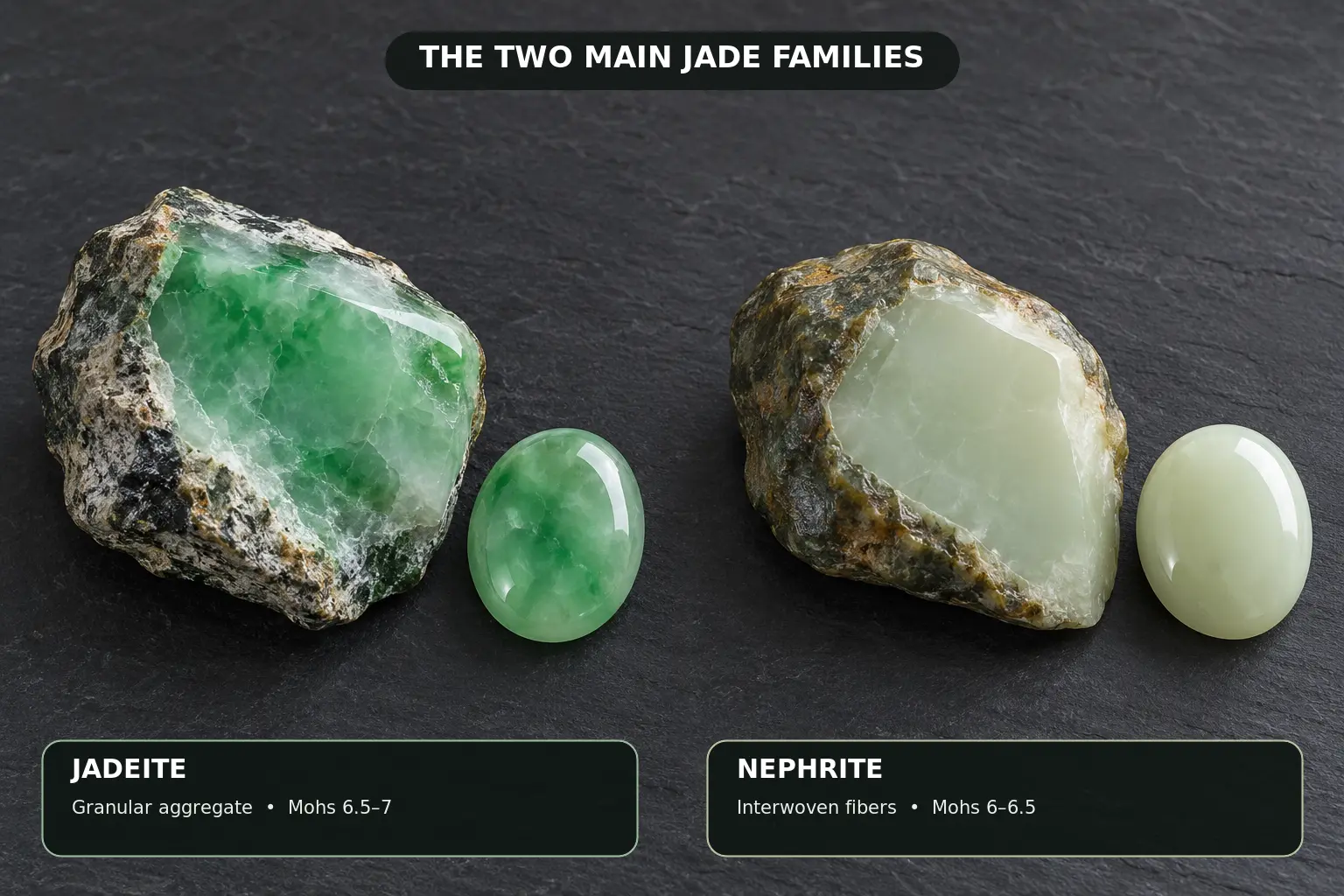
The two main jade families used in rings are jadeite and nephrite. Both are real jade. Jadeite is typically listed at Mohs 6.5–7 and nephrite at 6–6.5; both are exceptionally tough because their tiny crystals interlock. Color alone cannot separate them. Green, white, gray, black, yellow and brown material can occur in jade, while many non-jade stones can imitate the same colors.
Swipe sideways to compare the complete table.
| Stone named in a listing | Is it jade? | What a buyer may notice | What the listing should clarify |
|---|---|---|---|
| Jadeite | Yes | Very broad color range; translucent to opaque; fine to coarse granular texture | Treatment, exact dimensions and whether a lab report is included |
| Nephrite | Yes | Often creamy, gray-green, dark green, brown, black or white; commonly a smooth, fibrous-looking body | Treatment, exact dimensions and report details when relevant |
| Green omphacite | Sometimes included under jade in defined gemological contexts | Can overlap visually with dark or vivid green jadeite | The laboratory’s exact identification and terminology |
| Serpentine | No | Often soft-looking yellow-green, pale green or olive with a waxy appearance | Use “serpentine,” not only “new jade” or another jade trade name |
| Aventurine quartz | No | Green quartz that may show fine reflective mica sparkle | Use “aventurine quartz,” not only “Indian jade” |
| Dyed quartz or chalcedony | No | May show strong green color or color concentrated in cracks | Material and dye treatment |
| Glass, plastic or composite | No | Color may look unusually uniform; glass can contain rounded bubbles | Man-made composition, coatings and assembled construction |
Jadeite rings: wide color range and treatment questions
Jadeite is a pyroxene-rich metamorphic rock made from interlocking mineral grains. In rings it is commonly cut as a domed cabochon because the smooth surface displays color, translucency and texture without vulnerable facet edges. Jadeite can be green, white, lavender, yellow, orange-red, gray, brown or black. A bright green ring is not automatically jadeite, and jadeite is not automatically green.
When comparing jadeite rings, look beyond the color name. Fine texture can give the polished surface a smoother, more even appearance. Translucency can make the color feel deeper and more luminous. Fractures, strong color zoning, a very shallow cabochon or a poorly finished back can change both appearance and value.
Treatment disclosure is especially important. In common trade language, Type A jadeite refers to material that has not been acid-bleached, polymer-impregnated or dyed; traditional surface waxing after polishing may still be accepted. Type B refers to bleached and polymer-impregnated jadeite, while Type C refers to dyed material. Some pieces combine more than one treatment. These terms describe treatment, not beauty or quality, and they should not be casually applied to nephrite.
Nephrite rings: fibrous structure and exceptional toughness
Nephrite is an amphibole-rich rock with a tightly interwoven fibrous structure. It is slightly lower on the Mohs hardness scale than jadeite, but hardness measures resistance to scratching—not resistance to breaking. Nephrite’s structure gives it exceptional toughness, which is why it has a long history in tools, carvings and wearable objects.
Nephrite can be creamy white, pale celadon, gray-green, yellow-green, brown, black or deep spinach green. Its colors are often more muted than the saturated colors possible in jadeite, but that is a tendency, not a reliable home test. Fine white nephrite and evenly colored green nephrite can be highly desirable.
A seller should still disclose treatment and provide accurate dimensions. “Hetian jade,” “Canadian jade” or another geographic or trade description should not replace the material name. Origin can matter to collectors, but it is a separate claim that requires supporting evidence.
Jadeite is listed around Mohs 6.5–7 and nephrite around 6–6.5, so both can be scratched by harder materials. Their interlocking structures make them unusually resistant to chipping and breaking. A ring can therefore be very tough while still developing surface scratches from careless storage.
Where omphacite and “Fei Cui” fit
Omphacite is the part of jade terminology most likely to confuse a careful buyer. Modern gemological usage may include certain green omphacite under the generic term jade. Laboratory comments may also use the trade term “Fei Cui” for material composed of jadeite, omphacite and kosmochlor.
That does not mean every omphacite specimen should be marketed casually as jade. If a valuable ring is described as omphacite jade or Fei Cui, read the identification line and comments on the report rather than relying on a seller’s shortened title. The exact laboratory wording is more useful than trying to decide from a green photograph.
Common jade look-alikes used in rings
A look-alike is not automatically a bad gemstone. Serpentine and aventurine can make attractive, affordable rings. The problem begins when a different material is presented as jade or when a romantic trade name hides the species buyers are actually paying for.
Serpentine sold as “new jade”
Serpentine is a family of minerals that often produces smooth, waxy green material. Names such as “new jade,” “olive jade” or “Korean jade” may appear in the market, but those names do not make serpentine a form of jadeite or nephrite. Serpentine is generally softer and needs more protection from scratches in a ring.
Aventurine quartz sold as “Indian jade”
Green aventurine is quartz containing reflective mineral inclusions. Under direct light it may show a fine glittering effect called aventurescence. “Indian jade” is a misleading historical trade name; the useful material description is green aventurine quartz. It can be durable enough for jewelry, but its identity and market value are different from jade.
Dyed quartz, chalcedony and other green stones
Quartz and chalcedony can be dyed to imitate stronger jade colors. Some pieces reveal color concentrated around cracks or drill holes, but even color does not prove that a stone is untreated. Hydrogrossular garnet, calcite and other green materials also receive jade-like trade names. Ask for the mineral name instead of memorizing every marketing label.
Glass, plastic and assembled material
Glass can imitate translucency and color, while molded plastic can imitate a polished cabochon at low cost. Rounded gas bubbles, mold seams or an unnaturally uniform internal appearance can be warning signs, but their absence proves nothing. A composite may combine stone fragments, resin, backing or coatings. These materials should be disclosed clearly as man-made or assembled.
Green jade and white jade are colors, not species
This point solves many shopping mistakes. A green jade ring and a white jade ring describe visual choices; the names do not establish whether the stone is jadeite or nephrite. Both jade families can occur in green and pale colors, and non-jade materials can imitate both.
The same applies to celadon, moss, spinach, icy, lavender and black. These words help describe appearance, but they do not replace material identity, treatment disclosure or measured quality factors. If two rings have the same color label, compare them as individual stones.
How to read a jade ring listing
- Find the exact species. Prefer “jadeite” or “nephrite” over the unqualified word “jade.” If the listing says omphacite or Fei Cui, read the report language.
- Separate color from identity. Green, white and celadon describe what the stone looks like, not what it is.
- Look for treatment disclosure. Ask about dye, bleaching and polymer impregnation. “Natural stone” alone may describe origin without answering the treatment question.
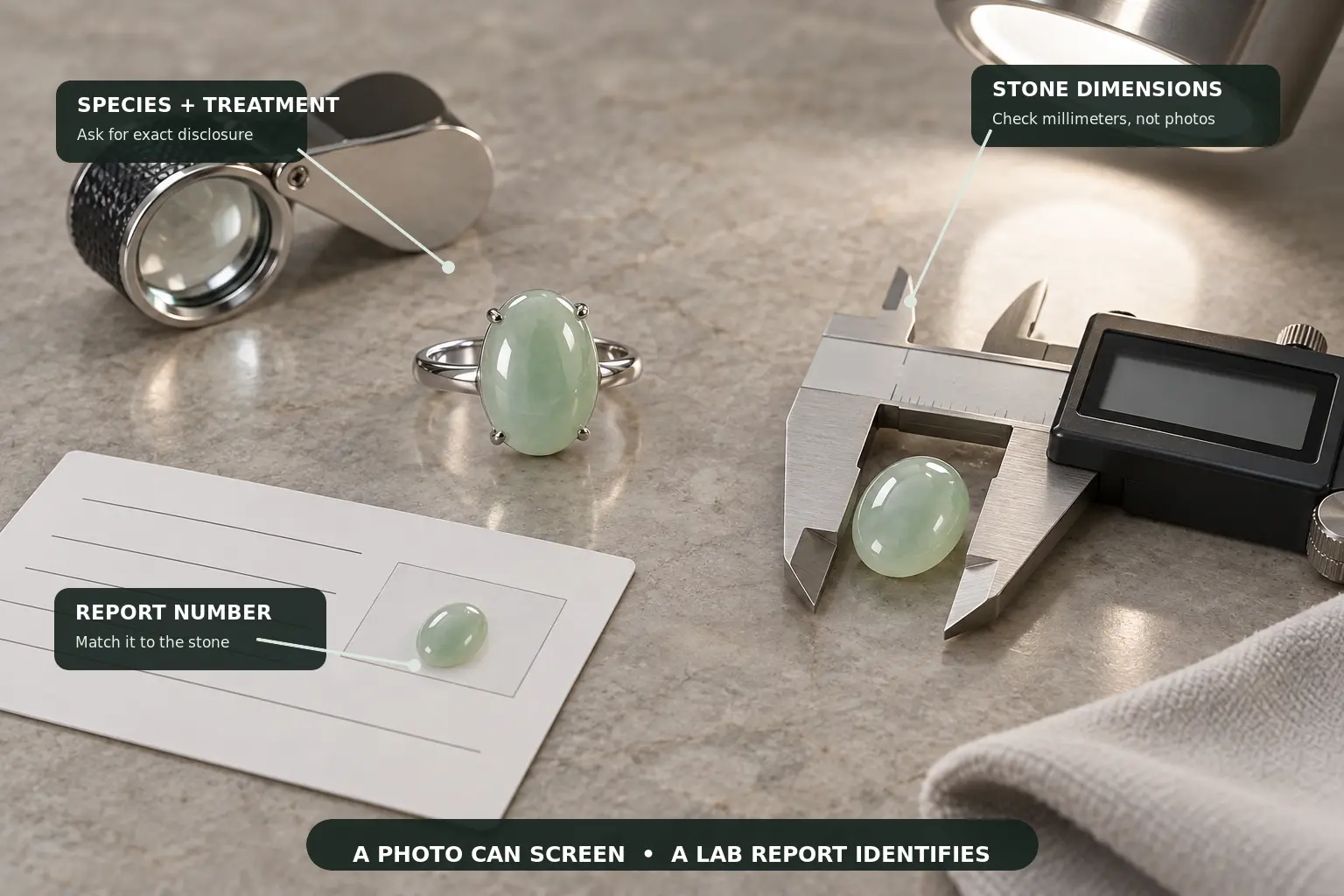
- Check millimeter dimensions. Stone length × width, full ring face, setting height and band width are more reliable than a close-up photograph.
- Inspect front, side and back. Check prongs or bezel, stone support, open areas, visible fractures and how high the cabochon sits above the finger.
- Match a report to the ring. If a report is included, compare its item description, weight or dimensions and report number with the actual piece.
- Read the metal description separately. Sterling silver, plated sterling silver, gold filled and solid gold describe the setting—not the jade species.
Can you identify a jade ring at home?
You can inspect workmanship and spot reasons to ask more questions, but you cannot reliably prove species and treatment with a flashlight, touch test, tapping sound or phone photograph. Genuine jade can look uniform; an imitation can look convincingly irregular. Temperature depends on room conditions and setting metal. Sound depends on shape and mounting.
Avoid scratch tests, hot needles, chemicals and impact tests. They can damage the stone, plating or setting and still fail to answer the question. A gemologist can combine refractive index, specific gravity, magnification, spectroscopy and other instruments to reach a defensible identification.
Photos can help you judge
Visible color, pattern, polish, cracks, ring profile, prong condition, approximate scale and whether the delivered piece resembles the listing.
Photos cannot prove
Jadeite versus nephrite, treatment, geographic origin or whether a jade-colored stone is actually serpentine, quartz or glass.
Which jade type is best for a ring?
There is no single winner. Choose jadeite when a particular color, translucency or fine cabochon appearance is the priority. Choose nephrite when you prefer its creamy, muted or deep green character and long carving tradition. In either family, a secure setting, comfortable profile, honest treatment disclosure and a stone you enjoy looking at matter more than the name alone.
For daily wear, protect both from hard knocks, abrasive surfaces and harsh chemicals. Clean with warm water, mild soap and a soft cloth. Because a ring may be treated even when you do not know it, this gentle method is safer than steam or ultrasonic cleaning.
Our current jade ring collection includes green, celadon and white designs. Use those color names to compare the look; use this guide to ask the separate material questions. For fit, construction and setting height, continue with how to choose a jade ring.
Frequently asked questions
Is jadeite the same as jade?
Jadeite is one of the two main materials recognized as jade. The other is nephrite. They are different rocks with different mineral structures, but both are genuine jade.
Is nephrite real jade?
Yes. Nephrite is genuine jade and has been used for tools, carvings and jewelry for thousands of years. It is not a fake or lower-grade form of jadeite.
Is white jade always nephrite?
No. Both jadeite and nephrite can be white or near-white, and several non-jade materials can look similar. The color cannot establish the species.
Is serpentine jade real jade?
Serpentine is a different material. It may be sold under trade names containing the word jade, but it is not jadeite or nephrite and should be identified as serpentine.
Is green aventurine a type of jade?
No. Green aventurine is quartz with reflective inclusions. It can be attractive jewelry material, but “Indian jade” and similar names do not make it genuine jade.
Can a flashlight tell jadeite from nephrite?
No. Backlighting may reveal translucency, cracks or color distribution, but it cannot reliably identify the material or treatment.
What should a jade ring lab report say?
Look for the material identification, whether treatments were detected, a clear item description and measurements or weight that can be matched to the ring. Read comments about terms such as Fei Cui rather than relying on the seller’s shortened title.
Buy the stone named on the evidence, not the color suggested by a photograph. Jadeite and nephrite are both real jade; certain green omphacite may also fall under jade in a defined laboratory context. Serpentine, aventurine quartz, dyed quartz and glass can be perfectly usable jewelry materials, but they should be disclosed and priced as what they actually are.