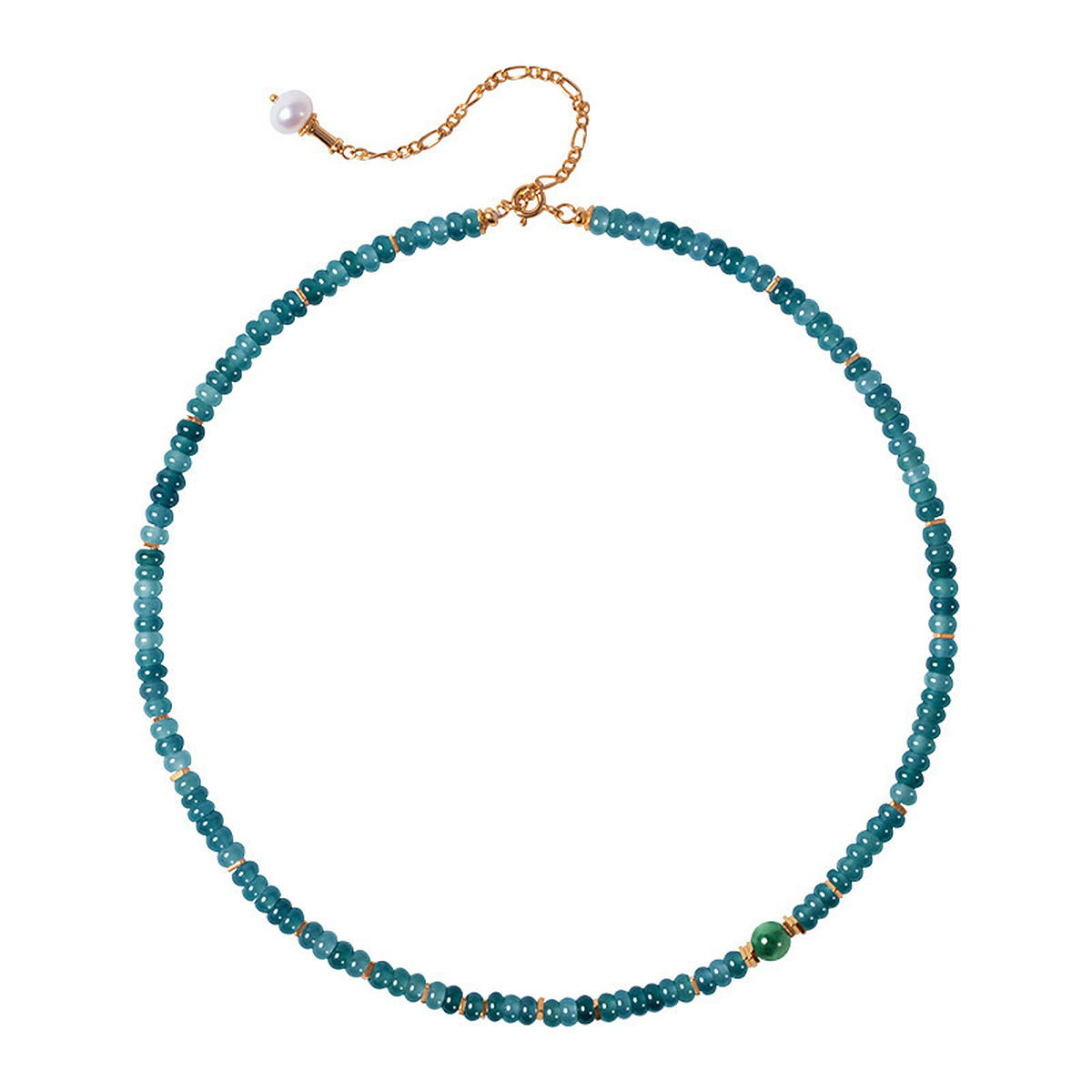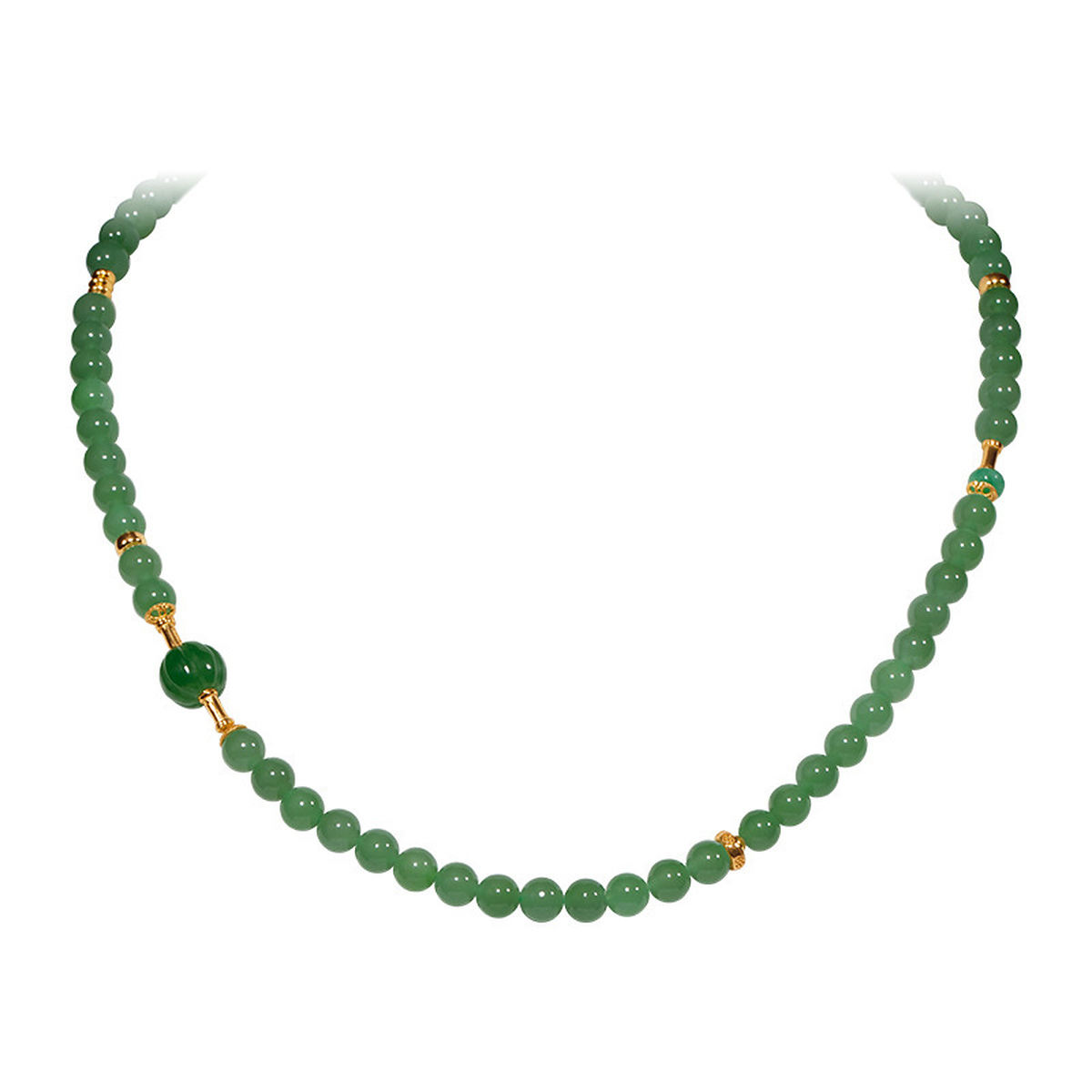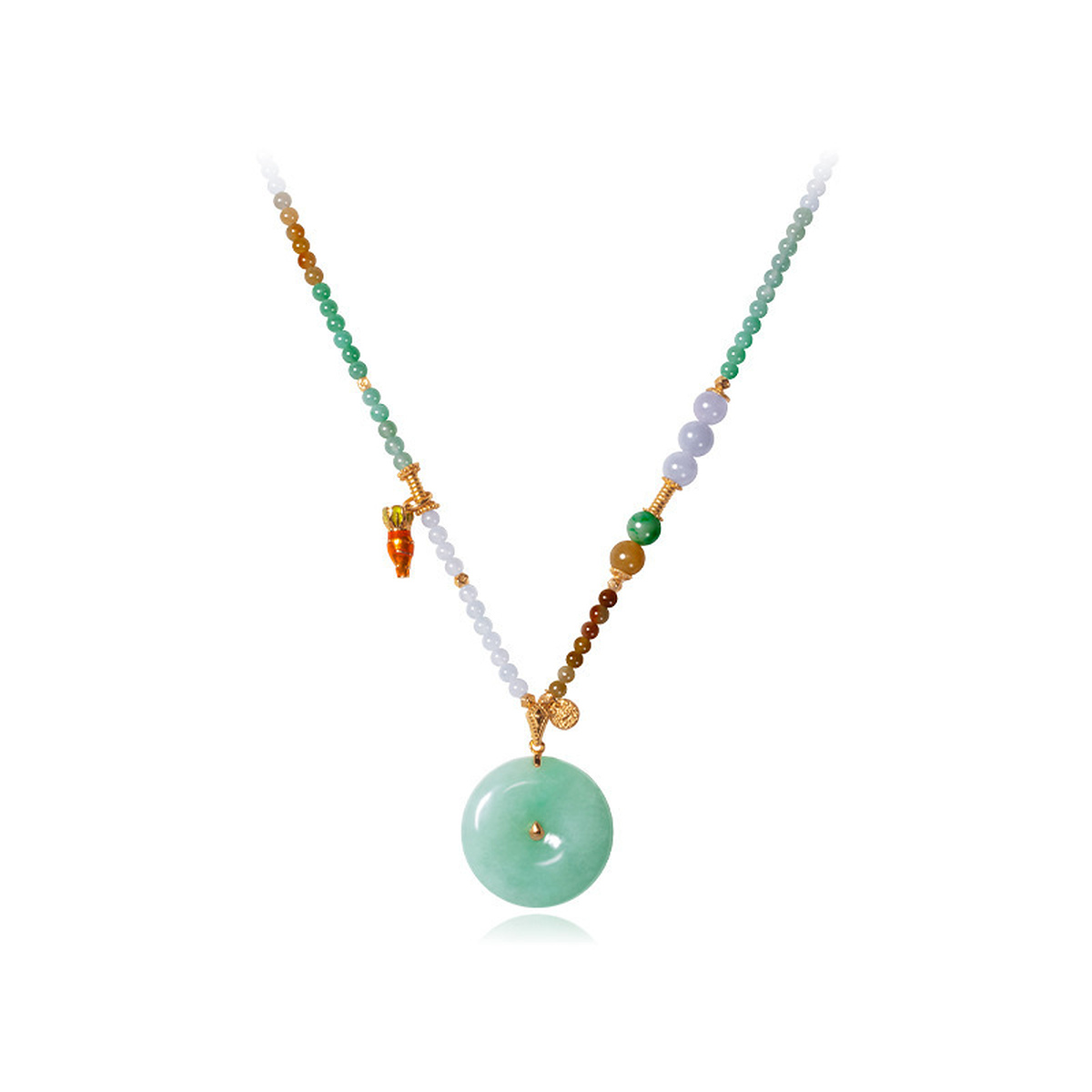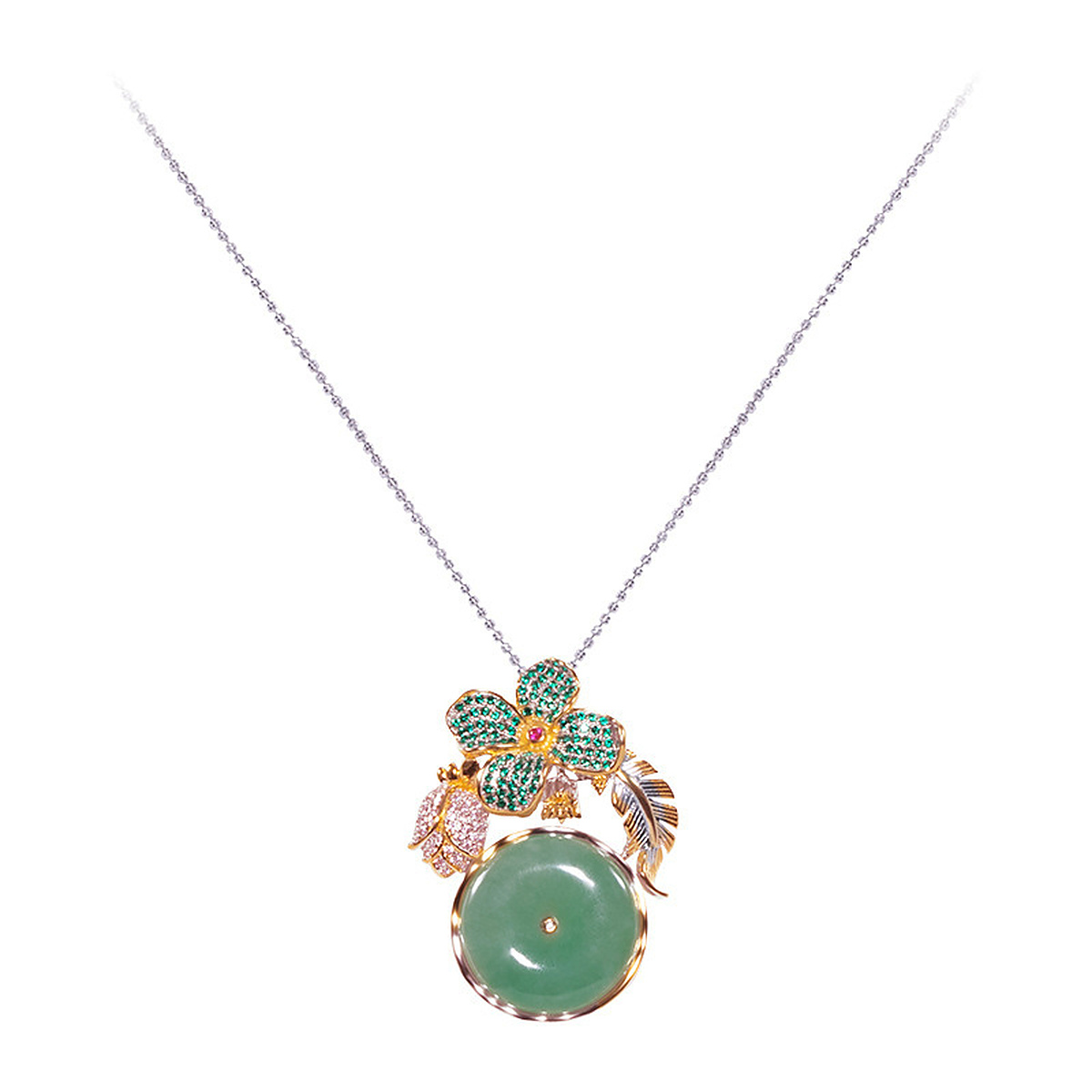
A jade necklace cannot be authenticated from color, weight, a cold touch, or one attractive product photograph. What you can do is screen the listing, inspect necklace-specific details, and decide whether the piece needs an independent laboratory report before you pay.
To tell whether a jade necklace is real, first ask what “real” is supposed to mean. Is the material jadeite or nephrite rather than glass or another stone? Has it been dyed, bleached, filled, or coated? And, in a mixed-material necklace, which individual parts are actually jade? Photos may reveal warning signs, but a qualified gemological laboratory is the reliable way to identify the material and detectable treatments.
This matters more with necklaces than with a single loose stone. A necklace may combine dozens of beads, a carved pendant, spacers, pearls, agate, cord, plated silver, and a clasp. The seller can describe the whole piece as a “jade necklace” even when only one component is jade. That does not automatically make the description dishonest—but the components should be named clearly.
Use an evidence ladder, not a magic home test
Look for the exact jade material, treatment disclosure, component list, measurements, weight, and clear return terms.
Study the surface, edges, drill holes, bead-to-bead variation, back of the pendant, settings, and construction.
For a valuable or disputed piece, obtain a report that identifies the material and lists detectable treatments.
The first two levels help you reject weak listings and obvious imitations. They do not turn a phone camera into a gem laboratory. GIA notes that “jade” is a general name for jadeite and nephrite—and, in limited conditions, green omphacite. GIA laboratories use instruments such as infrared and Raman spectroscopy because some look-alikes and treatments cannot be settled by appearance alone.
There are three separate questions hiding inside “Is it real?”
1. What is the material?
Jadeite and nephrite are both accepted jade materials. They are different mineral aggregates, and neither is made less “real” by being the other. A seller should ideally state jadeite or nephrite, not rely only on the broad word jade. “Hetian jade” is a trade and geographic term commonly associated with nephrite; it should not be treated as a laboratory species result unless a report says so.
2. Has the material been treated?
A piece may be genuine jadeite and still have been dyed, bleached and polymer-impregnated, or coated. In the widely used jadeite trade terminology, Type A generally means natural jadeite or jadeite polished with wax only; Type B is acid-bleached and polymer-impregnated jadeite; Type C is dyed jadeite. Combinations are also sold. These A/B/C terms belong primarily to the jadeite trade. Do not assume that a vague “Grade A” label proves untreated nephrite—or proves anything without supporting documentation.
3. Which parts of the necklace are jade?
On a bead strand, perhaps every bead is claimed as jade. On a pendant necklace, the carved focal may be jade while the smaller beads are pearl or amethyst. On another piece, the central carving may be agate and only the accents are jadeite. Read the material list component by component. This is often the fastest way to spot a description that is technically suggestive but not genuinely informative.
| Evidence | What it can tell you | What it cannot prove |
|---|---|---|
| Clear daylight photos | Visible color distribution, surface texture, cracks, polish, assembly and obvious bubbles | Exact mineral identity or absence of treatment |
| Drill-hole close-ups | Color concentrated near holes, chipped coatings, glue, rough workmanship or inconsistent cores | That every bead is natural, untreated jade |
| Measurements and weight | Whether the delivered necklace matches the listing and whether proportions are plausible | Authenticity by density; metal, cord and mixed stones affect total weight |
| UV flashlight | Fluorescence differences that may justify further examination | A simple pass/fail verdict; jade and treatments can respond in different ways |
| Lab report | Material identification and detectable treatments within the report’s stated scope | That every component was tested unless the report explicitly says so |
What to inspect in photos before buying
Ask for sharp, unfiltered images in indirect daylight, against a neutral background. You want at least a front view, back view, edge view, and close-up of a drill hole or setting. A video can help you judge translucency and surface reflections, but it is still visual evidence rather than identification.
Pendant on a chain or cord
Inspect both faces, the rim, the opening or drill hole, the bail, and any metal cup or foil behind the stone. A backing can change apparent color. Glue around a setting should be disclosed if it is part of the construction.
Uniform bead strand
Compare several beads, not just the best one near the clasp. Look into drill holes and examine color at the hole edges. Natural variation is normal; identical swirls, repeated bubbles, or a colored surface layer deserve questions.
Carved focal necklace
Check recessed carving lines, the back, thin edges, and high points. Dye or coating can collect in recesses or wear first at exposed edges, although clean surfaces still do not prove the absence of treatment.
Mixed-material necklace
Map every visible component to the material list. The main focal, accent beads, pearls, metal findings, spacers, cord and terminal should not be allowed to blur into one generic “jade” claim.
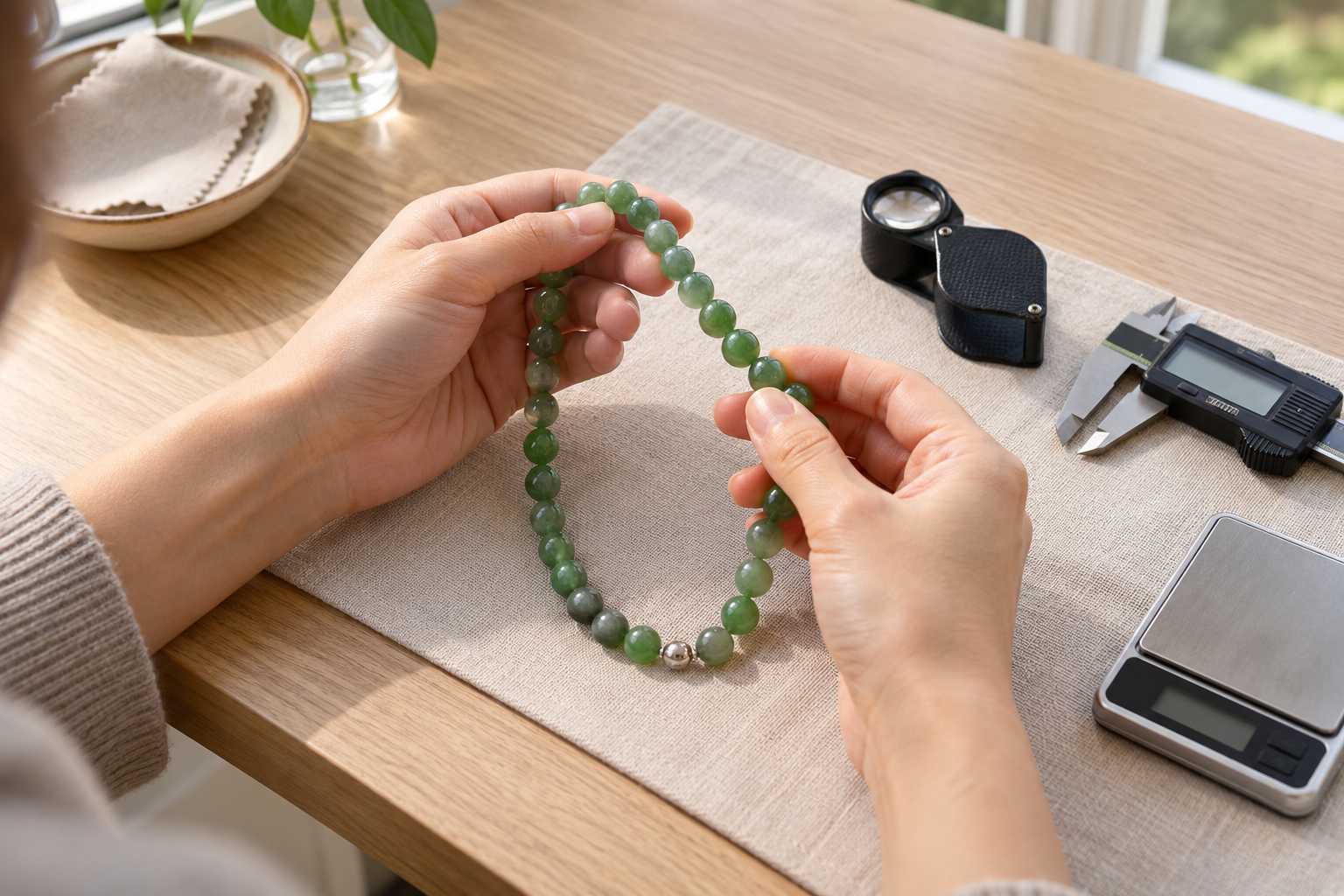
At-home screening setup
Use tools to document, not to guess
- Check color in indirect daylight.
- Inspect several beads with a 10× loupe.
- Measure bead and pendant dimensions.
- Compare total weight with the listing.
Look for clues, not “gotcha” features
Round gas bubbles visible inside a transparent material can point toward glass. A patch of color concentrated along a crack or drill hole can suggest dye. A peeling surface may indicate a coating. Mold seams, repeated patterns, or unusually soft edges can also raise questions. But the absence of these clues is not proof of jade. Good imitations and treated jadeite may look convincing, while genuine jade may contain inclusions, grain, pale areas, or surface-reaching fractures.
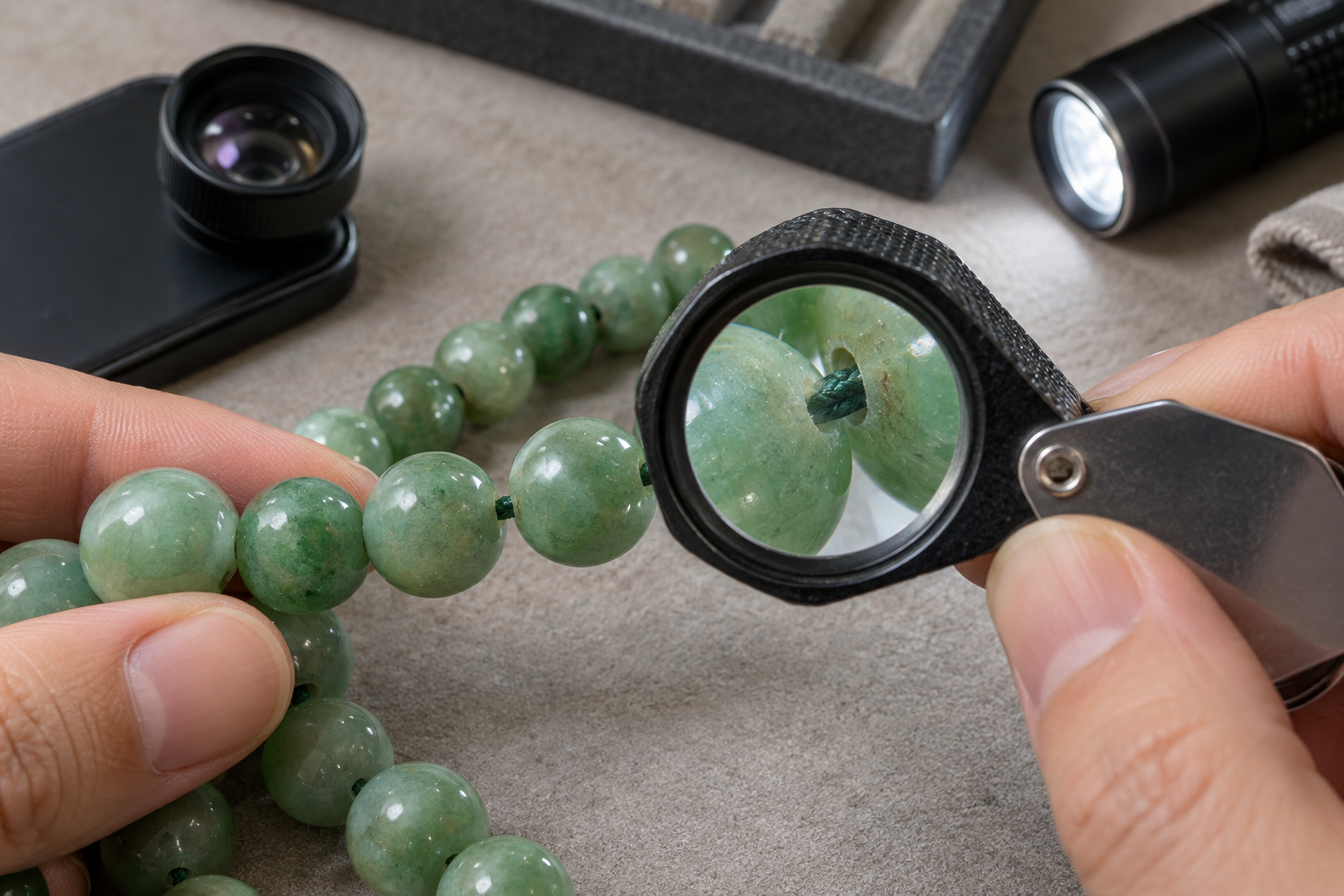
10× drill-hole inspection
The hole often shows what the front hides
- Look for a lifting surface film.
- Note color concentrated at the opening.
- Check for glue, filler or rough chips.
- Repeat the check on several beads.
Color is especially easy to misread online. Cameras alter white balance, product lights boost translucency, and phone screens differ. Jadeite may be green, lavender, white, yellow, brown, black, gray, or blue-toned. Nephrite also occurs well beyond green. A color that looks “too pale” is not automatically fake; a saturated green that looks expensive is not automatically jade.
A safe ten-minute inspection at home
- Save the original listing. Keep screenshots of the material description, measurements, weight, treatment statement, certificate claim, and return window.
- Use neutral light. Examine the necklace near a window without direct sun. Turn off beauty filters and compare the piece with the seller’s photos.
- Clean only if appropriate. A dry, soft cloth is enough for an initial check. Do not soak a necklace with cord, pearls, plated metal, glue, or unknown treatments.
- Use a loupe or phone macro lens. Study the back, edges, drill holes, recesses, clasp area, and several randomly selected beads. Note bubbles, pooled color, peeling film, glue, chips, and repairs.
- Measure it. Check overall length, bead diameter, pendant dimensions, and weight with ordinary jewelry tools. A mismatch does not identify the material, but it is objective evidence that the item differs from its listing.
- Compare components. Confirm which parts were claimed as jadeite, nephrite, pearl, agate, metal, or another material. Do not test the necklace as though every part were the same substance.
- Stop at uncertainty. If the value matters, the return deadline is short, or the treatment status affects your decision, consult an independent gemologist or recognized laboratory while the return option remains open.
Reasonable checks
- Neutral-light inspection
- 10× loupe or phone macro
- Dimensions and weight
- Report-number verification
- Independent lab testing
Skip these “tests”
- Scratching with a knife
- Hot needle or flame
- Dropping or striking the piece
- Acid or household chemicals
- Judging by cold touch alone
Destructive tricks can damage real jade, plated findings, cord, pearls, resin-treated material, and polished surfaces. They can also produce false confidence. A glass imitation can feel cool; many hard stones can resist casual scratching; and the sound of beads depends on shape, stringing tension, size, and contact—not just material.
Read a jade certificate as carefully as the necklace
The word certificate is not enough. Before paying a premium, check who issued the document and whether that organization can be contacted independently. A useful report should contain a report number, a description or photograph that matches the item, the tested material, detectable treatments, date, weight or dimensions, and a way to verify the record in the issuer’s own database.
Scope matters. A report for one pendant does not automatically authenticate the necklace’s 40 smaller beads. A report for “green stone” is less useful than one identifying jadeite or nephrite and addressing treatment. If the seller says “certified,” ask which component was tested, whether it was tested loose or mounted, and whether the report covers treatment as well as identity.
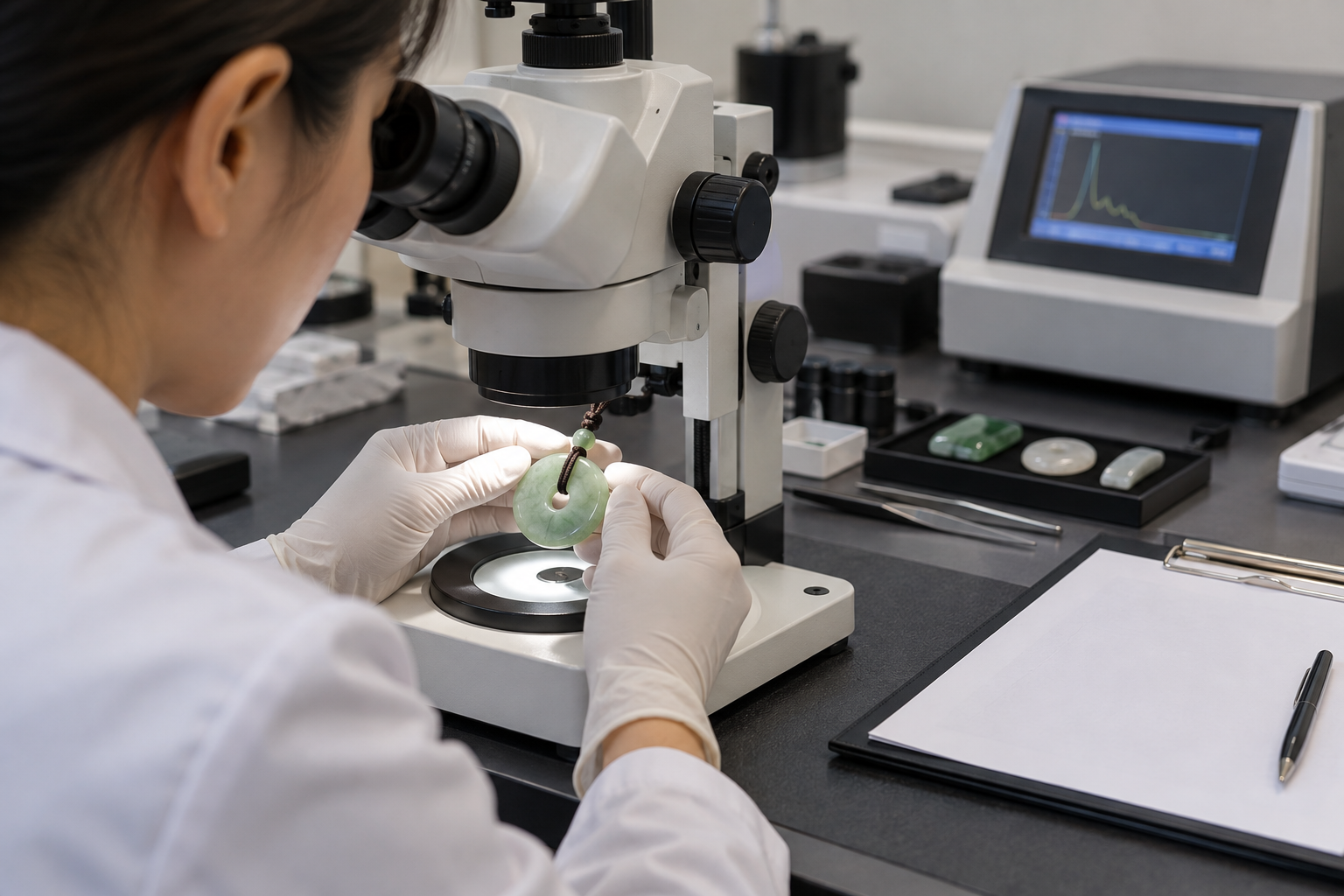
Independent laboratory evidence
A report should answer two questions
- What material was actually tested?
- Were detectable treatments found?
- Does the photo match this exact piece?
- Does the scope cover one part or all parts?
GIA’s current colored-stone identification service describes the material and lists detectable treatments for loose or mounted items. The U.S. Federal Trade Commission also advises consumers to ask whether a gemstone has been treated; sellers should disclose treatments that are not permanent, require special care, or significantly affect value. A report and an honest listing should reinforce one another rather than substitute for one another.
“Does this report identify the exact piece I am buying, and does it state whether detectable dye, polymer impregnation, or coating is present?” That gets closer to the purchase decision than simply asking whether the necklace is “real jade.”
Map every component before accepting the “jade necklace” label
A necklace can contain several materials, and the largest or most colorful component is not automatically jade. Use the listing to map each visible part before judging the claim.
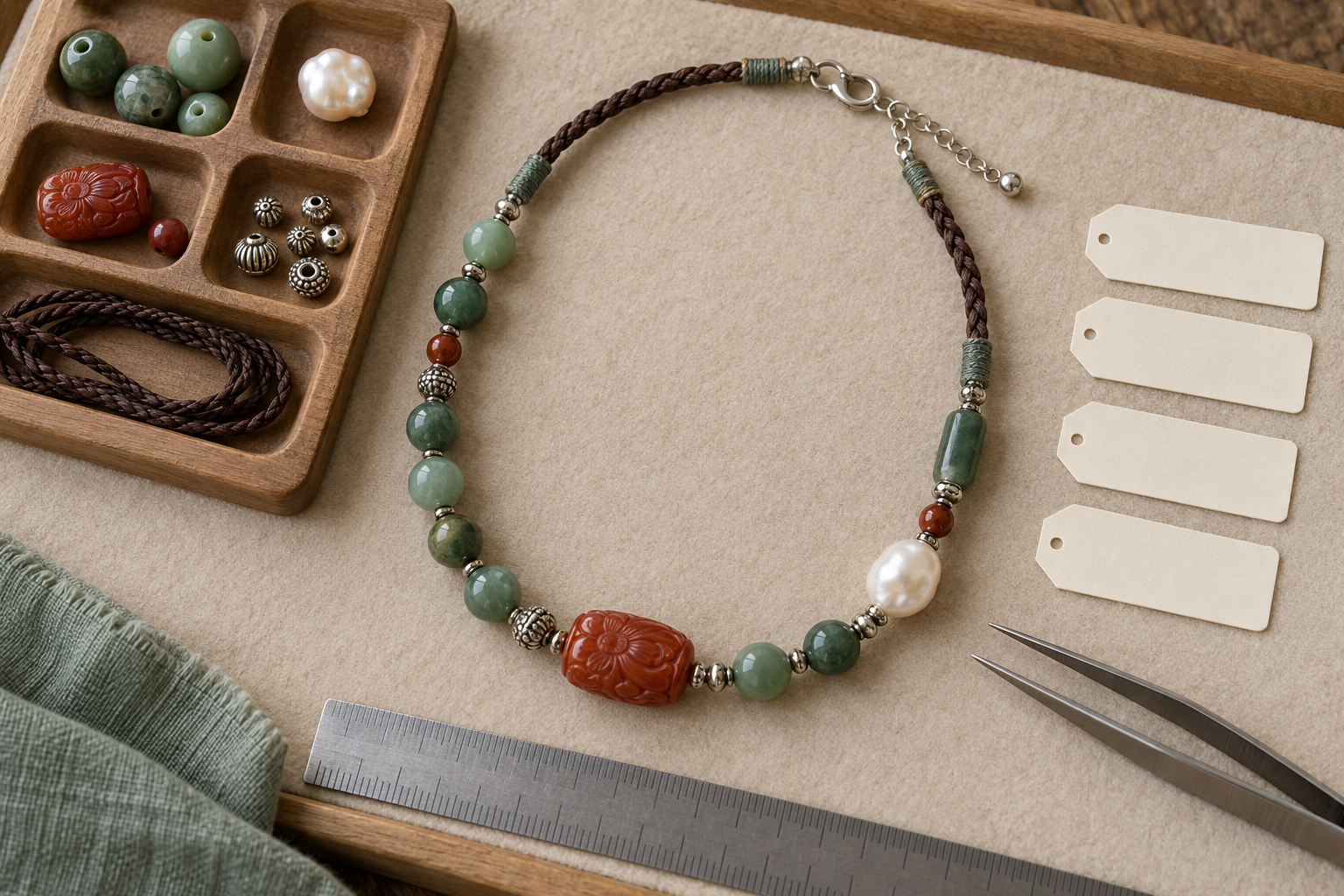
Mixed-material component map
“Jade necklace” may describe only one component
- Identify the focal carving.
- Name green and colored beads separately.
- Distinguish pearl from imitation pearl.
- List cord, spacers, clasp and metal finish.
Red flags in an online jade necklace listing
- “Natural jade” with no material name. Ask whether the claim is jadeite, nephrite, or another material.
- “Grade A” without an explanation. The seller should state what the term means and whether it is supported by a report.
- A certificate with no issuer or searchable report number. A decorative card printed by the seller is not independent evidence.
- One front photo only. You cannot inspect the back, edge, holes, setting, clasp, or repairs.
- No dimensions, weight, or component list. These are basic facts, even though they do not by themselves authenticate jade.
- Health, luck, or wealth promises in place of material disclosure. Cultural meaning can be discussed honestly; it is not a mineral test.
- Pressure to ignore the return window. High-value identification should be possible before your right to return expires.
- A price explained only by color. Jade value also depends on material, treatment, translucency, texture, workmanship, condition, provenance, and market demand.
A buying checklist you can copy
- Is the jade identified as jadeite or nephrite?
- Does the listing address dyeing, bleaching, polymer impregnation, coating, or other treatment?
- Are all non-jade components named?
- Are length, bead size, pendant size, weight, clasp, and metal stated?
- Can I see the front, back, edge, drill holes, and clasp in neutral light?
- If there is a report, can I verify its number on the issuing laboratory’s own website?
- Does the report match this exact piece and cover the components that matter?
- Is the return period long enough for independent inspection?
- Are care instructions appropriate for every material in the necklace?
- Would I still be comfortable with the purchase if a lab report changed the value?
If you are still choosing between chain, cord, pendant, and bead formats, read our jade necklace buying guide. If the cultural symbolism is part of your decision, our guide to jade necklace meanings separates traditional associations from claims a product cannot prove. You can also browse the full jade necklace collection and compare the stated materials and measurements directly.
Frequently asked questions
Does real jade always feel cold?
No. Jade often feels cool at first because of its thermal properties, but glass, quartz, metal-backed pieces and other materials can also feel cool. Room temperature, body heat, thickness and mounting all affect the result.
Can I scratch a jade necklace to test it?
Do not. A scratch test can damage polish, cord, metal, coatings and other stones, and an informal result does not reliably identify the material. Use non-destructive professional testing when authenticity matters.
Does real jade make a special sound?
The sound of beads depends on size, shape, thickness, stringing tension, fractures and what strikes them. A pleasant ring is not a certificate of material or treatment.
Can UV light reveal fake jade?
UV fluorescence can be a clue, but it is not a universal pass/fail test. Natural materials, polymers, dyes, waxes and adhesives may respond differently. Treat an unusual reaction as a reason for further testing, not a verdict.
Can photos prove that a jade necklace is real?
No. Good photos can show workmanship, visible defects, obvious bubbles, color concentrations, coatings and whether the received piece matches the listing. They cannot reliably establish mineral identity or rule out treatment.
Is perfectly even green color a sign of fake jade?
Not by itself. Natural jade can be fairly even or strongly mottled, while treated or imitation material can also show convincing variation. Examine color together with the surface, holes, structure, documentation and laboratory evidence.
What does Type A jade mean?
In common jadeite trade terminology, Type A means natural jadeite or jadeite finished with wax only. Type B refers to acid-bleached and polymer-impregnated jadeite; Type C refers to dyed jadeite. Ask for an independent report rather than relying on the label alone.
How should I test an inherited jade necklace?
Do not clean aggressively or remove stones first. Photograph it, record its weight and dimensions, preserve boxes or receipts, and take the intact necklace to an independent gemologist or laboratory experienced with jade. Ask whether the report covers one focal stone or multiple components.
A careful buyer can identify weak claims at home. A careful seller can provide exact materials, measurements, honest photos and treatment disclosure. But when the price or provenance matters, the final answer should come from an independent gemological report—not from a freezer, a key, a flame, or a viral video.