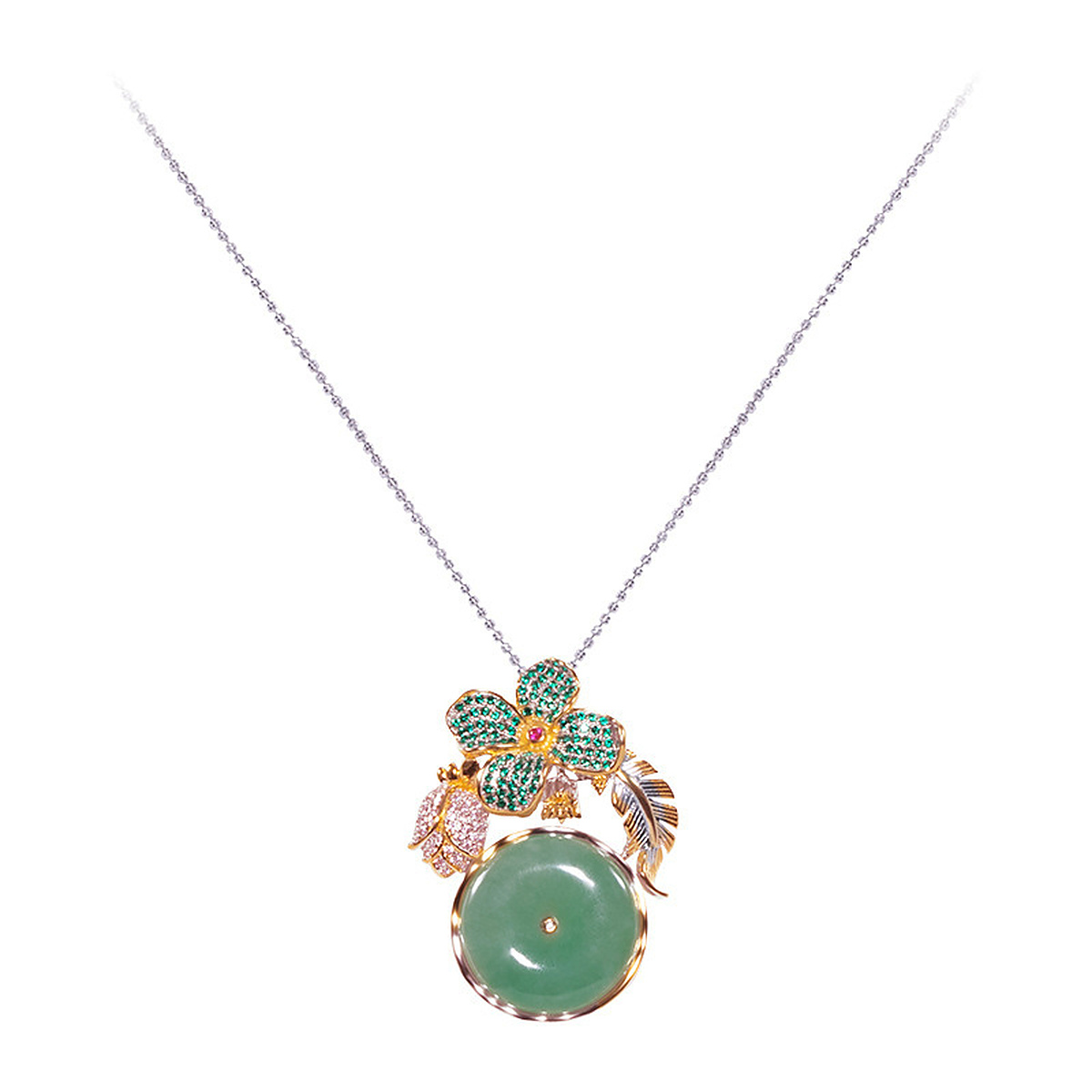
A jade necklace can carry several meanings at once. The stone may connect the wearer with family or cultural tradition. Its color may suggest a particular mood. A carved pendant may express peace, renewal or a good wish. Then a birthday, journey, relationship or private memory gives the piece a meaning no symbol dictionary can fully explain.
Jade necklaces are commonly associated with harmony, protection, good character, continuity and favorable wishes. Green often suggests growth and renewal; pale jade can feel calm and restrained; circular pendants are frequently read as completeness. These are cultural associations, not guaranteed effects. The most honest meaning comes from three questions: what is the material, what does the design show, and why was this particular necklace chosen?
Why a jade necklace can feel more personal than a list of symbols
People often search for one fixed translation—green means luck, a circle means protection, a lotus means purity. That is convenient, but it flattens a complicated object into a slogan.
A necklace sits near the face, throat and chest. It may be visible over clothing, tucked beneath a collar or held in the hand without anyone else noticing. A pendant can become a daily object long before it becomes a statement piece. That intimacy helps explain why jade necklaces are often chosen for family gifts, departures, milestones and new chapters.
Meaning also changes with context. A pale disc bought for yourself after a difficult year may stand for steadiness. The same form given by a parent before a move may feel protective. A green bead strand selected for its color may later become an heirloom. The object has not changed; the relationship around it has.
The five layers that shape jade necklace meaning
Rather than asking what every jade necklace means, read the piece from the material outward.
This layered approach also prevents two common mistakes: treating every green stone as authentic jade, and treating every symbolic association as a promise about health, money or fate.
What jade itself traditionally represents
Jade has been used for tools, personal ornaments, ceremonial objects and works of art in several cultures. In Chinese tradition, it became closely associated with what was valuable, refined and worthy of respect. Writers used jade as a metaphor for cultivated character, linking its qualities with ideas such as wisdom, justice, compassion, modesty and courage.
That history gives modern jade jewelry a broader foundation than “lucky stone.” A necklace may express a wish for safety or prosperity, but it can also stand for integrity, endurance, restraint and the effort to live well.
Material identity still matters. Jadeite and nephrite are different materials, and “Hetian jade” is generally discussed within the nephrite tradition. Neither mineral automatically carries a stronger meaning. The distinction affects what the necklace actually is, how it looks and how it should be described—not whether the wearer’s intention is sincere.
Jade necklace color meanings, without turning color into a promise
Color can help someone choose a gift or describe why a necklace feels right. It cannot prove authenticity, treatment status or value, and the same color does not mean exactly the same thing to every person.
| Color | Common association | A natural gift message | What color cannot tell you |
|---|---|---|---|
| Green | Growth, harmony, renewal and favorable progress | “For the next chapter” | Whether the stone is jadeite, nephrite, treated or another green material |
| Celadon | Quiet balance, restraint and ease | “For calm without standing still” | Quality, translucency or origin from a photograph alone |
| Lavender or pink | Grace, reflection, affection and emotional warmth | “Because softness can still be strong” | Whether the color is natural or enhanced |
| White or pale jade | Clarity, simplicity and an uncluttered beginning | “For a clear path forward” | Whether “white jade” is nephrite, jadeite or a different stone |
| Red accents | Celebration, warmth, vitality and auspicious energy | “For a joyful milestone” | That the red component is jade; it may be Nanhong agate, enamel, cord or another material |
| Multicolor | Several wishes, relationships or parts of a life held together | “For everything this year contains” | The identity of each bead or decorative accent |
What common jade necklace symbols can mean
Motifs make the message more specific, but they still need context. The safest wording is “commonly associated with,” not “guaranteed to bring.”
- Peace disc or ping’an kouThe smooth circular form is commonly associated with peace, completeness, protection and a wish for a steady path. Modern peace buckles are related to a long visual history of pierced jade discs, but they should not be presented as identical to every ancient ceremonial bi disc.
- Ruyi lockRuyi carries the sense of “as you wish” or favorable outcomes. Combined with a lock-inspired form, it can suggest safekeeping, enduring blessings and a good wish held close.
- LotusThe lotus is often connected with clarity, renewal and the ability to emerge from difficulty without losing one’s character. It suits a graduation, recovery or personal restart without needing to promise transformation.
- PeonyIn Chinese decorative tradition, the peony is associated with flourishing beauty, prosperity, honor and abundance. It often reads as celebratory rather than quiet or protective.
- Flowers and leavesFloral elements can suggest growth, seasons and renewal. A leaf may add the idea of continuity or a life that keeps unfolding.
- Abacus-shaped beadsAn abacus bead is first a recognizable form. Modern sellers sometimes attach ideas of calculation, work or prosperity to it, but there is no need to invent a fixed ancient meaning when the shape, rhythm and craftsmanship already explain its appeal.
Four real necklaces, four different ways meaning is built
The easiest way to understand symbolism is to look at an actual design and separate the material, motif, scale and wearing style.
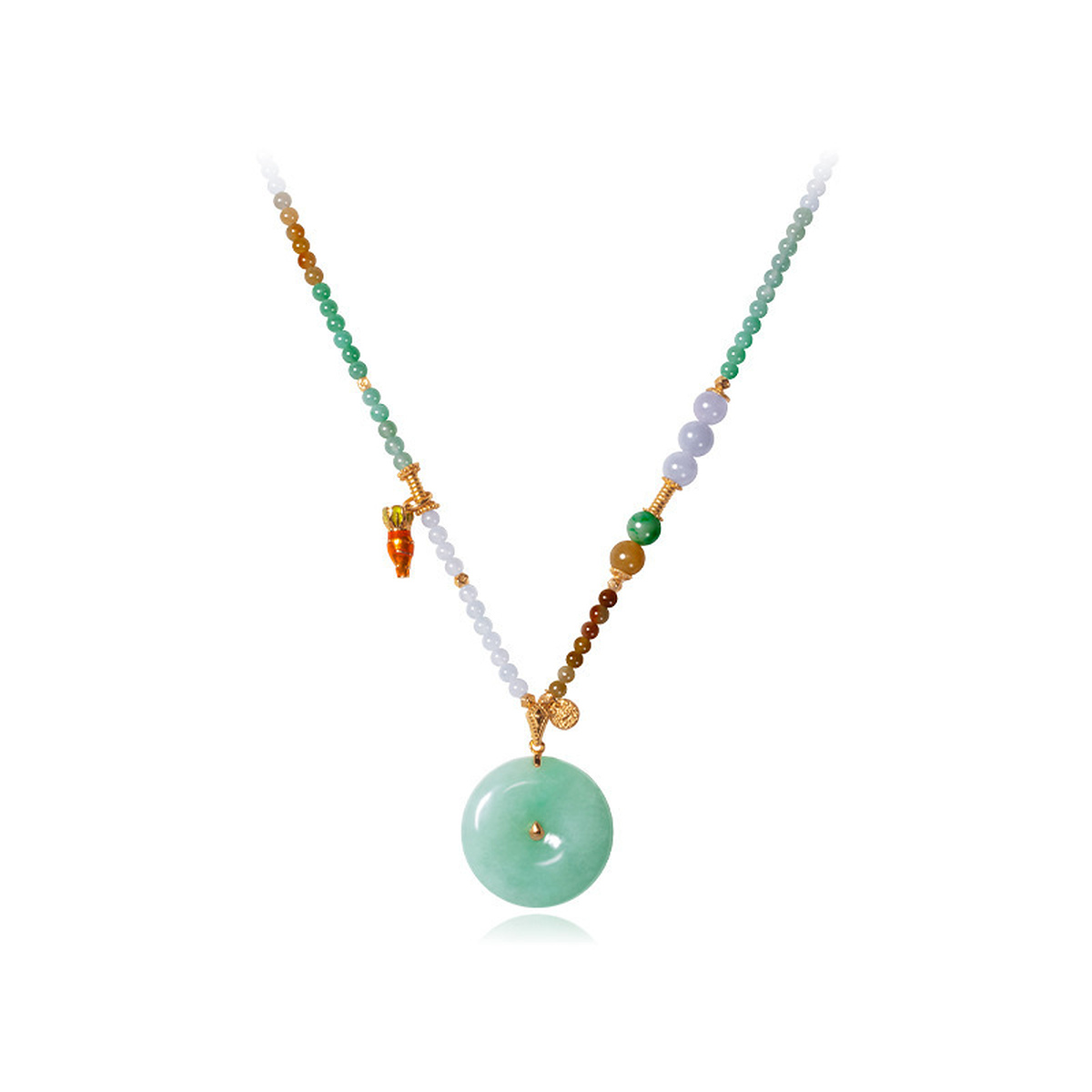
A 26 mm celadon ping’an kou gives the design its central message. Pearl, amethyst and several jadeite bead sizes make the necklace feel layered rather than ceremonial.
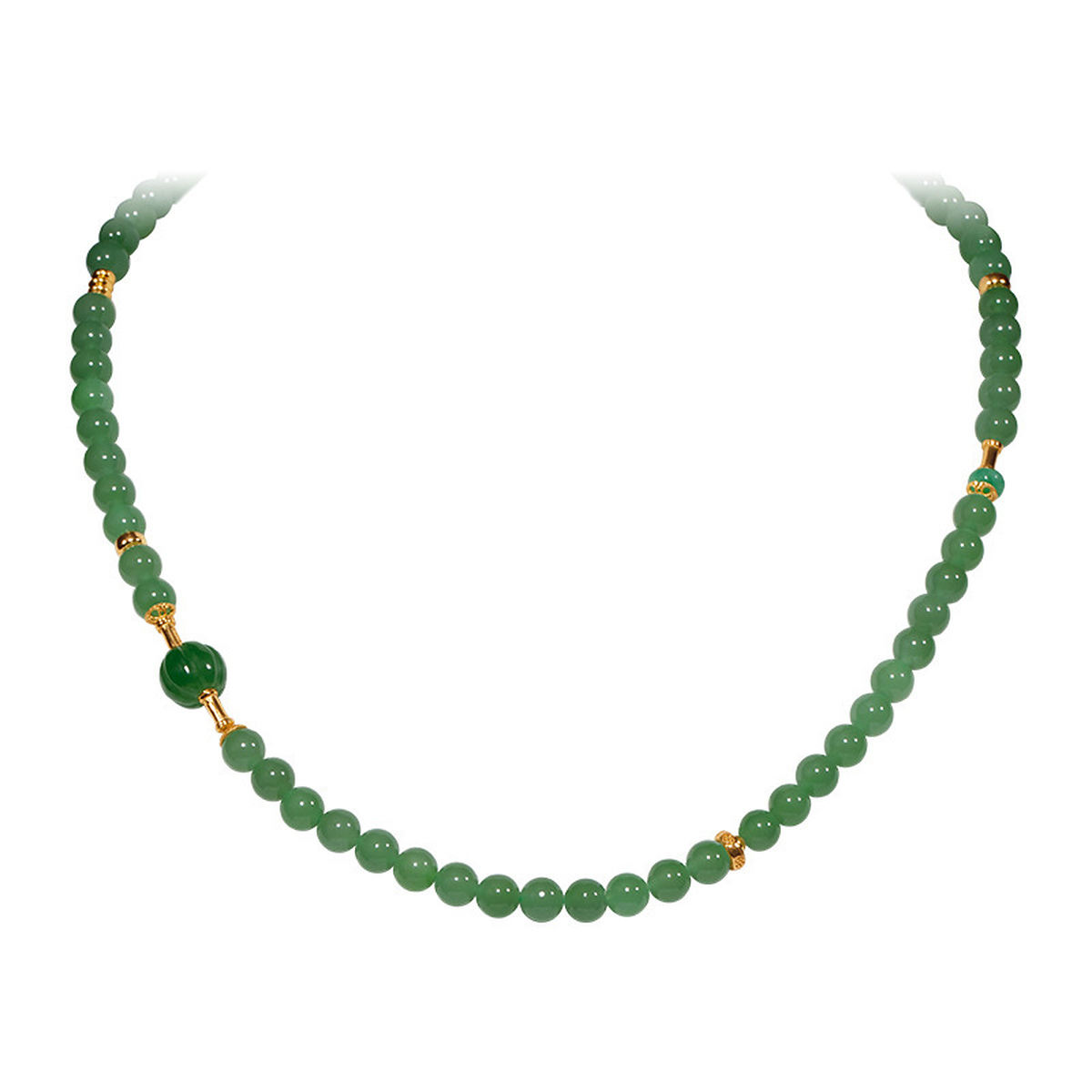
The repeated 6 mm nephrite beads create rhythm and continuity. A 9 mm carved lotus bead adds a discreet focal point associated with renewal and clarity.
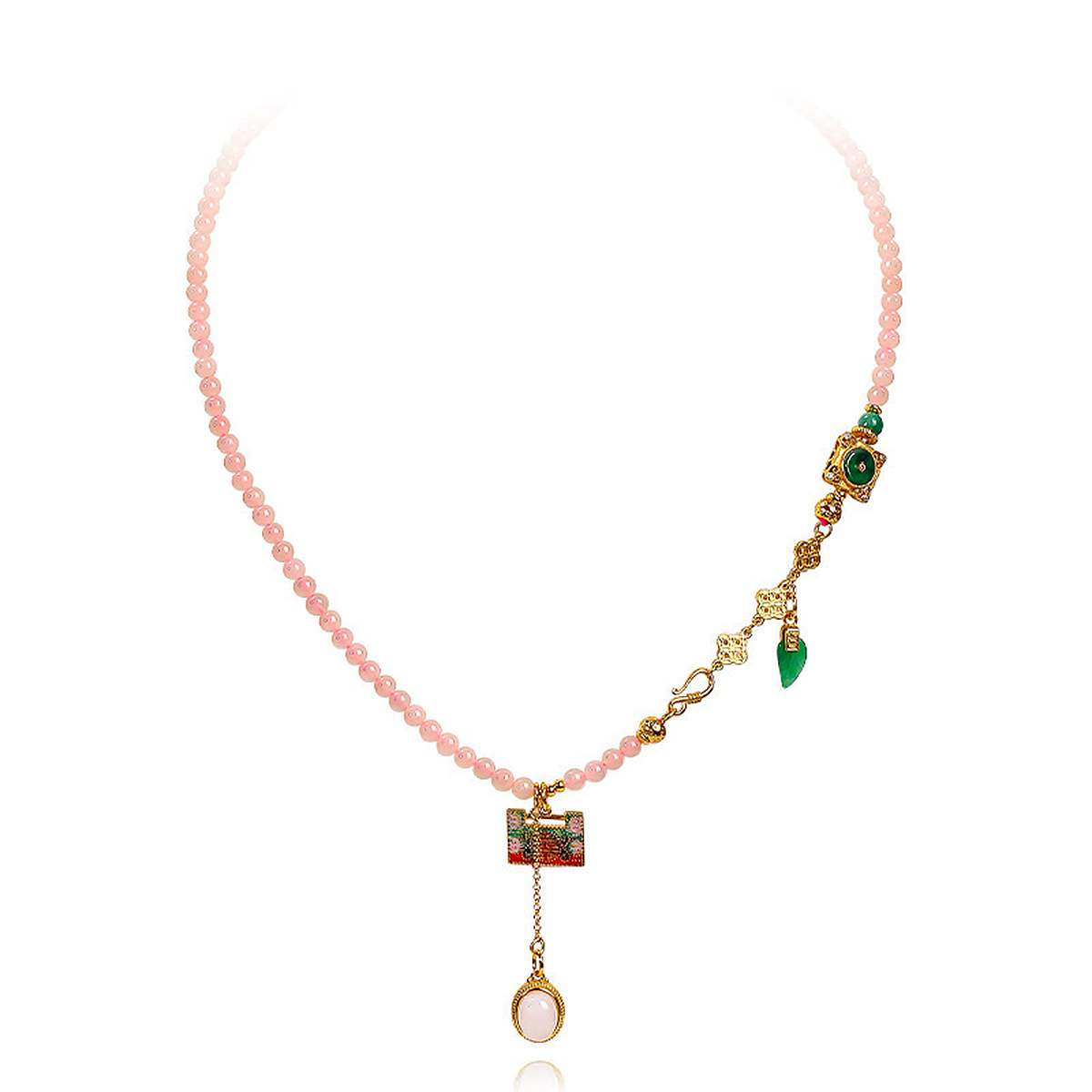
The ruyi-lock-style centerpiece gives the necklace its wish and safekeeping theme. The 77 cm strand changes the effect: it feels deliberate and visible rather than like a small hidden amulet.
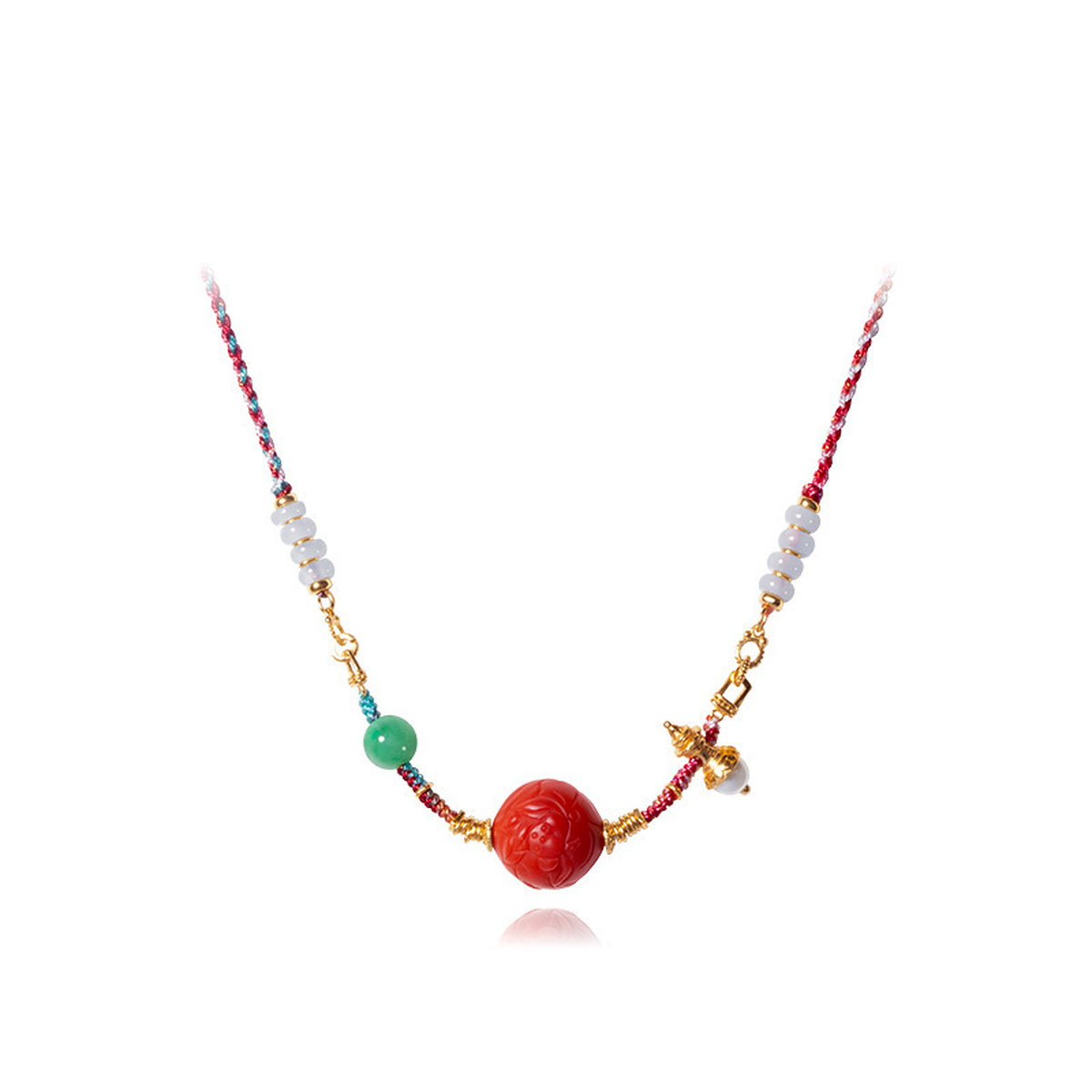
The 15 mm double-sided peony is Nanhong agate rather than jade. Jadeite, freshwater pearl and lotus accents support the story, showing why every component should be identified separately.
Symbolism becomes more credible when the description also gives verifiable facts: named materials, motif, dimensions, total length and construction.
Does a bead strand mean something different from a pendant?
Usually, yes—but the difference is emphasis, not a strict rule.
A jade bead necklace creates repetition. Visually, it reads as rhythm, balance and continuity. Small beads can feel understated and wearable; larger beads make the material itself the main event. Variation between natural beads can also remind the wearer that unity does not require perfect sameness.
A pendant necklace concentrates attention on one object. The message becomes easier to name: a peace disc, lotus, lock or carved figure. Length matters because a pendant worn high near the collarbone feels intimate, while a long pendant reads more like a visible statement.
A braided cord often gives a necklace a handmade, relaxed or traditional character. A fine metal chain can make the same jade shape feel more like conventional fine jewelry. Neither construction is spiritually stronger. The practical questions are whether the cord can be adjusted, whether the chain can support the pendant and whether the fittings are accurately described.
What does giving a jade necklace mean?
A jade necklace can make a thoughtful gift because the giver can choose both a physical design and a message. The message should still be written or spoken. Do not expect the recipient to decode a color or motif exactly as you intended.
| Occasion | A fitting direction | What you might say |
|---|---|---|
| Graduation or new job | Lotus, green jade or a clean circular pendant | “For steady growth in whatever comes next.” |
| Travel or moving away | Peace disc or a compact pendant comfortable enough for daily wear | “A small reminder that you are still connected to home.” |
| Mother or family member | Nephrite bead strand, peace motif or a color connected with a shared memory | “I chose something lasting because that is what you have given me.” |
| Partner or anniversary | Ruyi, circular forms or a piece whose materials reflect their usual jewelry | “Not for luck—for the life we are already building.” |
| Recovery or difficult transition | Lotus, celadon tones or a simple tactile pendant | “For patience, steadiness and room to begin again.” |
| Gift to yourself | The design you will actually wear, even if it has no dramatic traditional motif | “I wanted an object that marks this part of my life.” |
How to choose meaning without buying a marketing story
A meaningful necklace still needs honest product information. Use this order:
- Confirm what the materials are. Ask whether the jade is jadeite or nephrite and identify pearl, agate, enamel, glass and metal components separately.
- Read the actual motif. A round pendant may be a modern peace-disc design, but not every pierced circle needs an ancient ritual label.
- Check scale and construction. A 23 mm disc on a fine chain wears differently from a 26 mm disc on a bead strand. Meaning will not compensate for an uncomfortable length or weak fitting.
- Treat color as expression, not evidence. Choose a color because it fits the wearer or message, then verify identity and treatment through disclosure rather than appearance alone.
- Write the reason down. One honest sentence about why you chose the necklace is more memorable than ten generic claims about luck.
- Avoid guaranteed outcomes. Jewelry can carry hope, faith and intention. It cannot guarantee safety, health, wealth or a change in fate.
If you are still deciding between pendant size, necklace length and construction, use our practical jade necklace buying guide before choosing the symbolism.
What if a jade necklace breaks?
Some families interpret a broken piece of jade as having absorbed misfortune or protected the wearer. That belief can be emotionally meaningful, especially when the necklace was a family gift. It is not something gemology can prove.
The physical explanation is usually simpler: a cord wears through, a knot loosens, a clasp fails, a bail rubs against a chain or the pendant suffers an impact. Keep every component, photograph the original order of the beads and ask a jeweler or experienced stringer whether the necklace can be repaired safely.
A repaired necklace does not lose its meaning. For many people, visible repair becomes part of the story: the piece mattered enough to keep.
Questions people ask about jade necklace meaning
Does a jade necklace bring good luck?
Good luck is a cultural or personal belief, not a result jewelry can guarantee. A necklace can still serve as a meaningful reminder of hope, steadiness, family or a goal the wearer has chosen.
What color jade necklace is the luckiest?
There is no objectively luckiest color. Green is widely associated with growth, harmony and favorable progress, but pale, lavender or multicolor jade may fit a particular person or occasion better.
Does a jade necklace have to be a gift?
No. Family gifting traditions can add emotional weight, but buying jade for yourself is not disrespectful or less meaningful. The reason you chose it can become its own story.
Can someone outside Chinese culture wear a jade necklace?
Yes. Wear it with curiosity and respect. Use accurate names for the material and motif, avoid claiming one universal cultural interpretation, and do not present spiritual associations as guaranteed powers.
What does a jade peace buckle necklace mean?
A modern peace buckle or ping’an kou is commonly associated with peace, completeness, protection and a smooth path. The circular opening and uninterrupted outline reinforce the idea of balance and continuity.
What does a green jade necklace mean?
Green jade is commonly linked with growth, renewal, harmony and prosperity. The exact meaning still depends on the material, form, motif, giver and wearer.
Do jadeite and nephrite necklaces have different meanings?
They can have different histories, appearances and market identities, but there is no universal rule that assigns one spiritual meaning to jadeite and another to nephrite. Describe the mineral accurately and read the actual design.
Should a symbolic pendant face a particular direction?
Some figurative carvings have a visually intended front, but a plain disc, lotus bead or abstract form may not. Follow the construction of the bail or cord and the maker’s description rather than inventing a rule.
Can I wear a meaningful jade necklace every day?
Often, yes, if the length, clasp, cord and pendant weight suit daily wear. Remove it for swimming, strenuous exercise and situations where it may catch or receive a hard impact, especially when the design also includes pearl, plated metal or braided cord.
Look for accurate materials, a wearable length and a symbol you can explain in your own words.
Necklaces with clear colors and symbols