Jade Necklace Guide
How to Choose a Jade Necklace
A jade necklace should feel right on the body and make sense on paper. This guide shows you how to read a listing, translate measurements into real scale, and notice the construction details that decide whether a piece becomes an everyday favorite.
If you have ever opened two jade necklace listings and wondered why similar-looking pieces feel completely different in price, proportion, or character, begin with the details the camera cannot decide for you. A bright photograph may catch your attention, but stone disclosure, dimensions, weight, wearable length, and the way the pendant is carried will tell you far more about how the necklace will actually look and feel.
Choose the necklace in this order: understand how the stone is described, look at color and translucency in ordinary light, check the pendant in millimeters, check the total weight, decide where you want it to sit, and then inspect the bail, cord, chain, clasp, and adjuster. When one of those details is missing, ask rather than filling the gap with an assumption.
Start with what the listing can actually tell you
“Jade” is a familiar name, but it is not a complete product description. Jadeite and nephrite are the two gem materials most buyers encounter under that name. They can overlap in color, and neither can be identified reliably from a polished photograph alone. A useful listing should therefore say how the seller identifies the material and whether any known treatment has been disclosed.
Treatment information matters because dyeing, bleaching and impregnation, coatings, or other processes can change appearance, care requirements, and buying expectations. “Natural-looking” is not a treatment statement. If a laboratory report is offered, the report number, measurements, and pictured item should correspond to the necklace being sold.
Before concentrating on shade, look for a few plain facts:
- Is the material named as jadeite, nephrite, or simply “jade”?
- Does the description state untreated, treated, or treatment unknown?
- Are the photographs of the actual piece or a representative sample?
- Are pendant dimensions, weight, and full wearable length provided?
- Can the seller explain the metal, cord, clasp, and return terms?
A careful answer is more useful than a confident but unsupported label. If the necklace appeals to you and the disclosure is limited, decide whether the price and return policy fairly reflect that uncertainty.
Look at the stone in ordinary light
Green may be the color most closely associated with jade, but it is not the only color worth considering and it is never the whole story. White, celadon, lavender, yellow, gray, brown, and near-black jade can be equally compelling when the tone suits the design. The more practical question is whether you enjoy the color in the kind of light in which you will wear it.
Compare three things together. Color describes hue, lightness, and saturation. Translucency describes how softly light enters the stone rather than simply reflecting from its surface. Texture affects whether the polished surface appears fine and even or more visibly granular. Natural clouds, mottling, and color transitions can give a piece character; they should not automatically be confused with damage.
Ask for a normal daylight view as well as a backlit view. Backlighting can reveal translucency and internal variation, but it can also make a stone appear brighter than it will against clothing. A side photograph is helpful for judging thickness, edge finishing, and whether a visible line reaches a drill hole or outer edge.
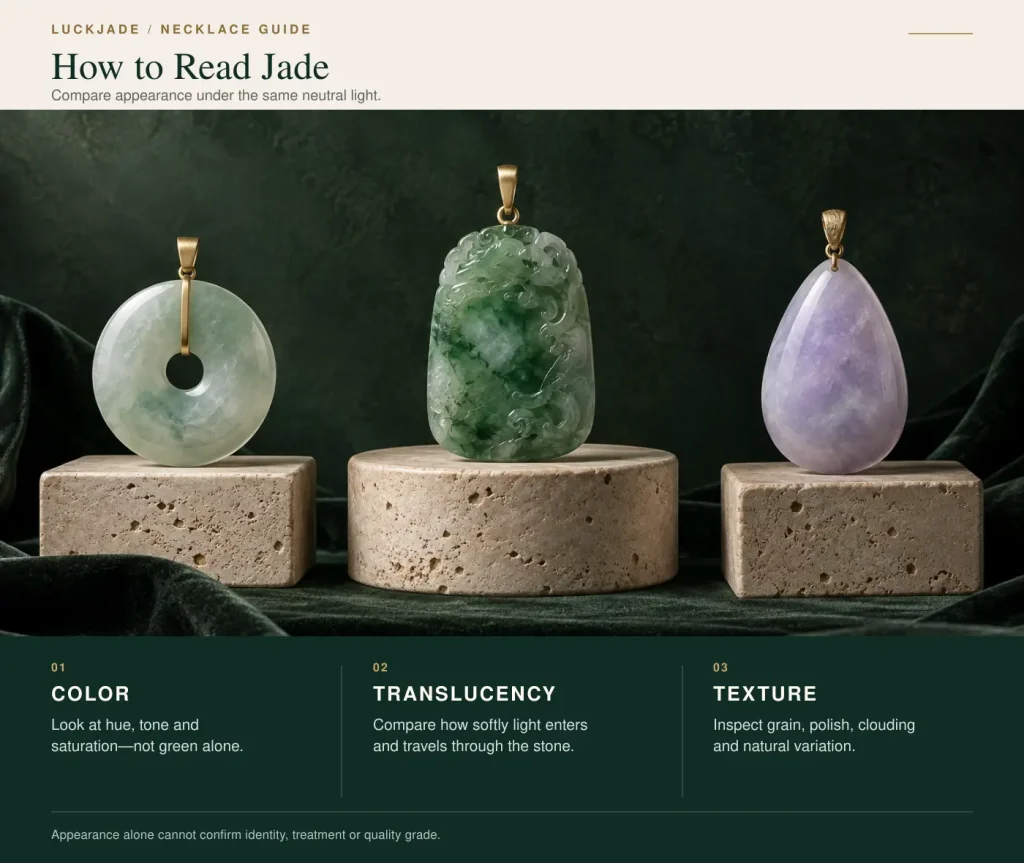
A practical photo set: front, back, side, normal light, backlight, and one frame beside a ruler. Six honest photographs usually answer more questions than one heavily edited hero image.
Make the pendant size real before you order
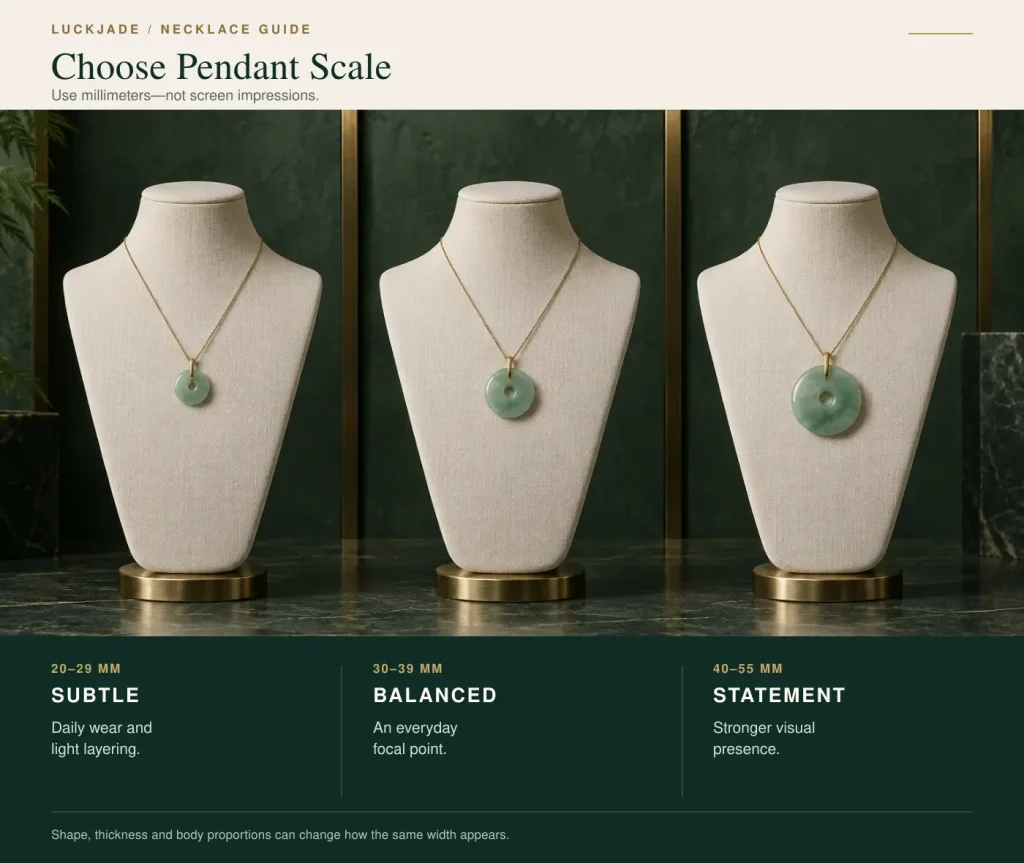
Online close-ups remove almost every clue to scale. A 23 mm disc and a 40 mm disc can fill the same amount of screen, even though they create very different impressions on the body. Use the written measurement, not the apparent size of the image.
One simple test is to draw the stated diameter on a piece of paper, cut it out, and hold it near the neckline where you expect to wear the pendant. This takes less than a minute and often changes a buying decision. If thickness and weight are listed, consider those too: a compact carved pendant may feel more substantial than a wider, thinner disc.
| Pendant width | How it usually reads | Useful context |
|---|---|---|
| 20–29 mm | Quiet and easy to layer | Everyday wear, smaller discs, lighter visual presence |
| 30–39 mm | A clear focal point | Visible with open necklines or over a simple top |
| 40–55 mm | Statement scale | Larger carvings and outfits built around the pendant |
These ranges describe visual scale, not quality. Shape, carving, thickness, setting, and the wearer’s frame all influence how a measurement looks.
Choose length by where the pendant should land
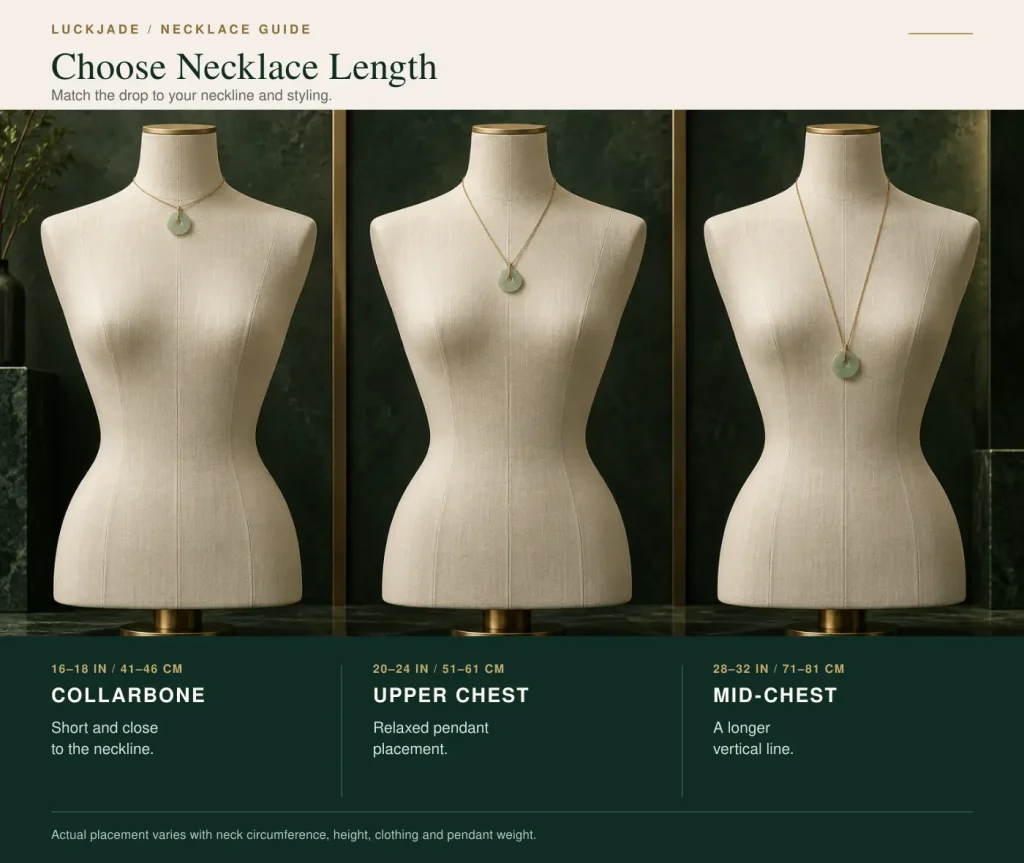
Necklace length is most useful when translated into placement. A short necklace brings a small pendant close to the face. A medium length gives the pendant breathing room on the upper chest. A long cord creates a stronger vertical line and can work well over knitwear or a closed neckline.
| Wearable length | Approximate placement | Often works with |
|---|---|---|
| 16–18 in / 41–46 cm | At or near the collarbone | Open necklines, smaller pendants, close layering |
| 20–24 in / 51–61 cm | Upper chest | Crew necks, relaxed drops, visible focal pendants |
| 28–32 in / 71–81 cm | Mid-chest or lower | Adjustable cords, knitwear, long vertical styling |
These positions are approximate. Neck circumference, height, clothing, and pendant weight all change the drop. For a gift, an extender or adjustable cord is usually more forgiving than a fixed short chain. For layering, compare the complete drops—including pendants—not only the chain lengths.
Then inspect what holds the stone
A necklace is a small system. The stone may be the reason you notice it, but the carrier determines whether it is comfortable and secure. Zoom in where the cord or metal meets the pendant. A drilled hole should look smooth, with enough material around it to avoid a fragile edge. A bail should have an opening large enough for the chain and should sit without pulling the pendant sideways.
For braided cord, look for even tension, tidy knots, and a clean adjuster. For a metal chain, check the stated metal, link weight, clasp type, and whether the chain can support the pendant without looking visually thin. Mixed materials deserve extra attention: pearl, plated silver, adhesives, and cord may need gentler care than the jade itself.
Comfort is part of construction. A heavy pendant on a narrow chain can pull at the neck, while a stiff cord may not settle naturally. If the total weight is given, compare it with a necklace you already own rather than judging the number in isolation.
Two jade discs that wear very differently
Real measurements make the difference easier to picture. LuckJade currently has two celadon disc necklaces that look related in close photographs but serve different wardrobes.
| Detail | Pearl & amethyst necklace | Braided-cord necklace |
|---|---|---|
| Jade disc | Approx. 26 mm / 1.02 in | Approx. 23 mm / 0.91 in |
| Total weight | Approx. 28 g | Approx. 12 g |
| Wearable length | 42 cm + 14 cm extender 16.5 in + 5.5 in |
Adjustable 51–80 cm 20.1–31.5 in |
| Character | Beaded detail and a shorter jewelry-like silhouette | Lighter feel and a much wider adjustment range |
The 3 mm difference between the discs is modest. The larger difference comes from weight and length. At about 28 g, the beaded necklace has more presence and sits within a shorter range. At about 12 g, the braided-cord version is lighter and can move from upper chest to a much longer drop. This is why a useful comparison looks beyond the centerpiece.
Let symbolism stay personal
Circular jade forms such as the bi and the contemporary ping’an kou are often associated with harmony, wholeness, balance, safety, and well-being. That history can make a disc necklace meaningful as a gift, a reminder, or simply a shape you enjoy wearing.
Symbolism should add context, not make a promise. A necklace cannot guarantee luck, health, protection, or financial results. The most convincing way to present meaning is to explain the form honestly and let the wearer decide what it represents to them.
Care for the whole necklace, not only the jade
Jade is known for toughness, but it can still be scratched, and necklace components may be more delicate than the stone. A simple routine is usually enough: wipe the piece after wear, clean gently with mild soap and warm water when needed, remove residue, and dry the pendant, bail, clasp, and cord completely.
Avoid prolonged soaking when a necklace includes pearl, braided cord, plated metal, glued fittings, or materials with unknown treatment. Keep it away from bleach, harsh acids, abrasive cleaners, perfume overspray, and hard impact. Store it separately so chains do not tangle and harder jewelry does not rub against the polished surface.
Every few months, check the points that move: the clasp, jump rings, knots, adjuster, bail, and the edge of any drill hole. Replacing a worn cord early is easier than finding a lost pendant.
Before you click checkout
Pause on the listing and make sure you can answer the questions below. You do not need perfect information for every purchase, but you should know where the uncertainty is.
- How is the stone identified?
- What treatment information is disclosed?
- Are the photographs of the actual necklace?
- What are the pendant width, thickness, and weight?
- What is the minimum and maximum wearable length?
- What are the chain, cord, bail, and clasp made from?
- Does the scale suit the intended wearer and neckline?
- Are care guidance and return terms clear?
Questions buyers often ask
What should I ask before buying a jade necklace online?
Ask whether the stone is described as jadeite or nephrite, whether known treatments are disclosed, and whether the dimensions and photographs refer to the actual piece. Confirm the weight, wearable length, carrier material, clasp or adjuster, and return terms as well.
Is darker green jade always more desirable?
No. Color is only one part of appearance. Translucency, texture, polish, natural variation, treatment status, craftsmanship, and personal preference also matter. Jade also occurs in white, lavender, yellow, gray, black, and other tones.
What jade pendant size is comfortable for everyday wear?
Many people find pendants around 20–30 mm easy to wear. Pieces around 30–40 mm create a more visible focal point. Thickness, weight, carving, and body proportions can make two pendants of the same width feel different.
What necklace length works with most outfits?
A 16–18 inch necklace usually sits near the collarbone, while 20–24 inches falls lower on the upper chest. Adjustable cords offer more flexibility. The actual drop depends on the wearer and the pendant.
How can I judge jade from product photographs?
Look for front, back, side, normal-light, and backlit views, plus a photograph beside a ruler. Images can help you compare appearance and construction, but they cannot confirm mineral identity or treatment status.
How should I clean a jade necklace?
Use a soft cloth and a small amount of mild soap in warm water. Avoid soaking pearls, braided cords, plated metal, glued fittings, or materials with unknown treatments. Rinse carefully and dry every component completely.
Compare the measurements before choosing the style
Browse LuckJade necklaces with pendant dimensions, weight, materials, and wearable length listed together.