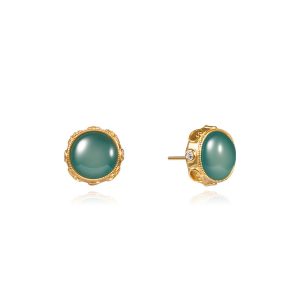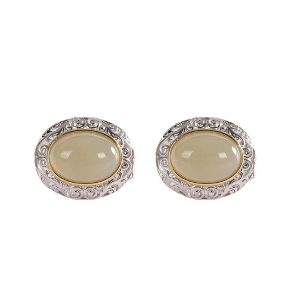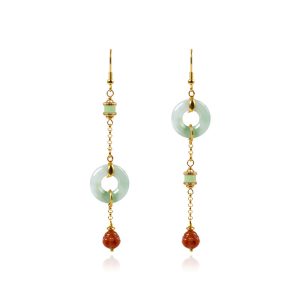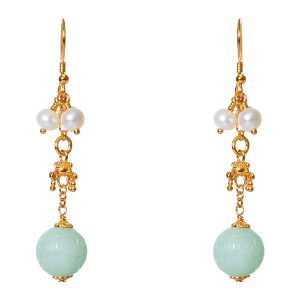
The most useful jade earrings for your face shape are not chosen by a rigid chart. They are chosen by watching where the stone sits, how far it drops, how wide it appears, and whether its movement balances—or deliberately echoes—your natural proportions.
Begin with proportion, then decide whether you want contrast or repetition. Narrow drops can add a vertical line beside a round face; curved jade discs can soften a strong jaw; studs and compact clusters can add width without extending a long face. But hairstyle, neck length, glasses, earlobe position and the actual millimeter size often matter more than the label “round,” “square” or “heart.”
Face-shape advice is useful only when it helps you compare real earrings. “Wear long earrings for a round face” is incomplete. A 22 mm narrow drop and a 65 mm statement earring are both long, yet they create very different lines, weights and levels of movement. Jade also has visual mass: an opaque carved bead reads more strongly than an open metal outline of the same dimensions.
Find your proportions without forcing yourself into one category
Use a straight-on photograph taken at eye level, with your hair pulled away from the jaw. Compare three things: overall face length, the widest point, and the shape of the jaw. Do not use a close selfie taken from below or with a wide-angle phone lens; perspective distortion can make the forehead, nose or jaw look wider than it is.
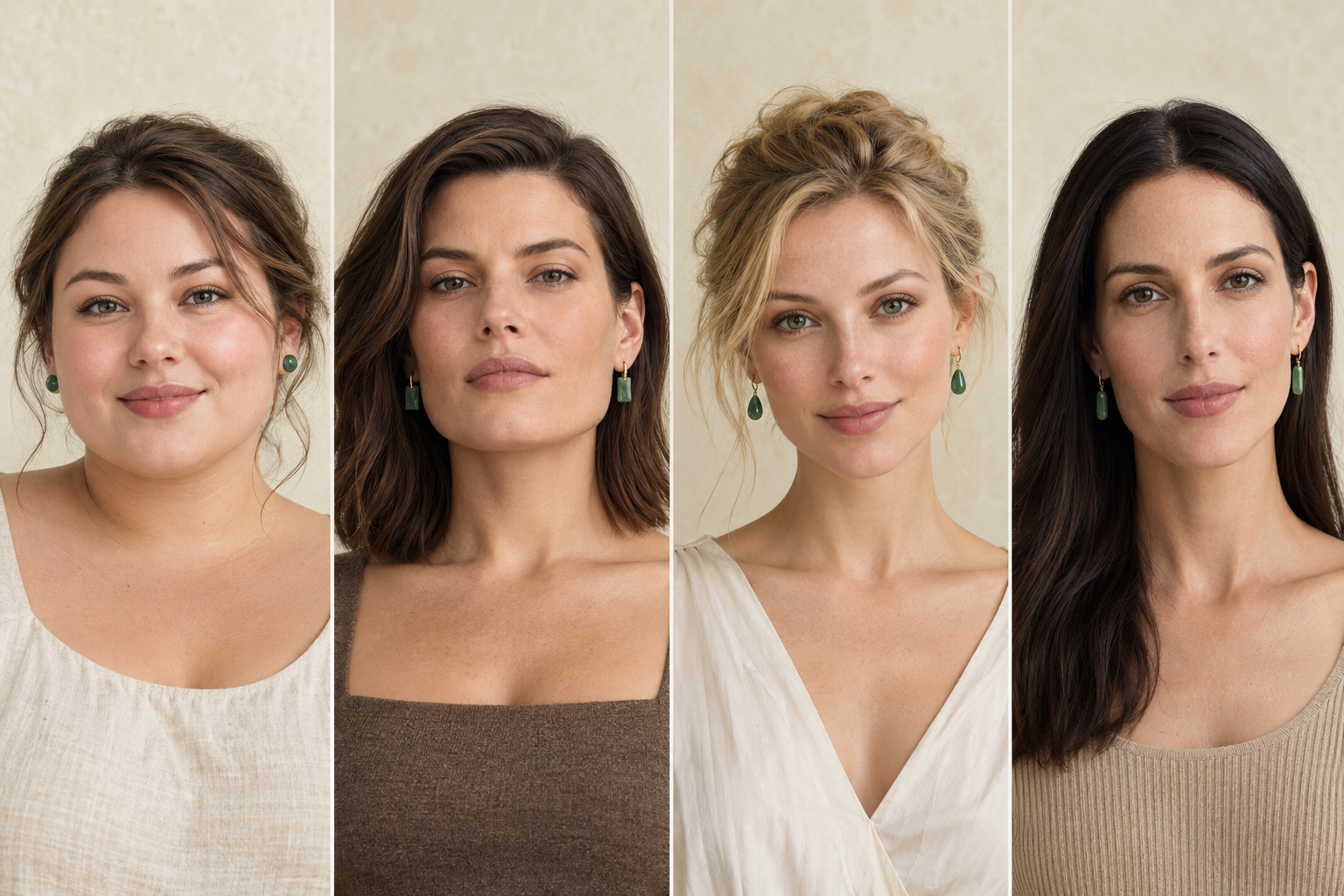
| Proportion | Useful starting point | Jade earring shapes to try | Check before buying |
|---|---|---|---|
| Round | Add a clear vertical direction | Narrow drops, slim carved beads, asymmetric vertical designs | Avoid choosing by length alone; check visible width at the widest point |
| Square | Introduce curves or movement | Discs, ovals, pear shapes, articulated drops | See whether the lowest element ends beside the jaw or below it |
| Heart | Add visual weight below the earlobe | Teardrops, bead drops, designs that widen toward the bottom | Very top-heavy studs may repeat forehead width rather than balance it |
| Long or oblong | Build width close to the ear | Oval studs, carved clusters, short rounded drops | Very thin long drops may extend the vertical line more than intended |
| Oval | Choose by scale and personal emphasis | Studs, discs, carved drops, asymmetric pairs | Match the earring to your features, hairstyle and occasion |
| Diamond | Balance prominent cheekbones | Compact studs, soft teardrops, drops with a gentle lower curve | Check whether the widest part competes with or supports the cheekbone line |
Round faces: create direction without adding unnecessary bulk
A round face is often close in width and length, with a softly curved jaw. A narrow drop can create a clean vertical path from the earlobe toward the neck. Jade bead drops, slim rectangular elements and asymmetrical designs can work well because the eye follows their direction rather than reading one wide circle beside another.
This does not mean avoiding every round earring. A small jade disc with an open center, a narrow metal frame, or a drop below it may still feel light and directional. The practical question is not “Is it circular?” but “How much solid width sits beside the fullest part of the face?”
Square faces: use curves, articulated joints and lower movement
A square face has relatively similar widths across the forehead, cheekbones and jaw, with a more defined lower line. Curved forms—oval jade cabochons, rounded beads, discs and pear-shaped drops—can introduce a contrasting rhythm. An articulated earring is especially useful because it does not create one rigid line parallel to the jaw.
Look at where the earring ends. A wide solid piece ending exactly at the corner of the jaw can visually reinforce that horizontal point. A shorter stud or a drop extending clearly below it creates a more deliberate relationship.
Heart-shaped faces: move visual weight below the earlobe
A heart-shaped face is generally wider through the forehead and cheekbones and narrows toward the chin. Earrings that gain width or visual detail toward the bottom can echo that taper in reverse. Teardrops, pearl-and-jade combinations, carved beads and small lower motifs are useful starting points.
Pay attention to the top connector. A very wide top cluster plus a tiny lower drop may keep all the visual weight beside the temple. A modest hook or stud leading to a clearer lower element usually produces a more balanced result.
Long or oblong faces: add width before adding more length
Long faces have more vertical distance than width, often with relatively straight sides. Jade studs, oval cabochons, clustered beads and short drops can place color close to the ear without extending the face. Wider carved motifs also work when their actual weight remains comfortable.
If you enjoy long drops, you do not need to avoid them. Choose a design with visible width, a curved lower element, multiple articulated parts or a contrasting pearl rather than one extremely thin uninterrupted line.
Oval and diamond faces: decide what you want to emphasize
Oval faces tend to have balanced proportions, so the useful decision is usually scale rather than category. A small stud keeps attention on the eyes and cheekbones; a jade drop adds movement and draws the gaze toward the jaw and neck.
Diamond-shaped faces are widest at the cheekbones with a narrower forehead and jaw. Compact studs can highlight that natural structure, while soft teardrops and rounded lower shapes can add visual weight below the cheekbone. Avoid treating the face shape as a problem to “correct.” The goal is control over emphasis.
Stud or drop? The same face can support both
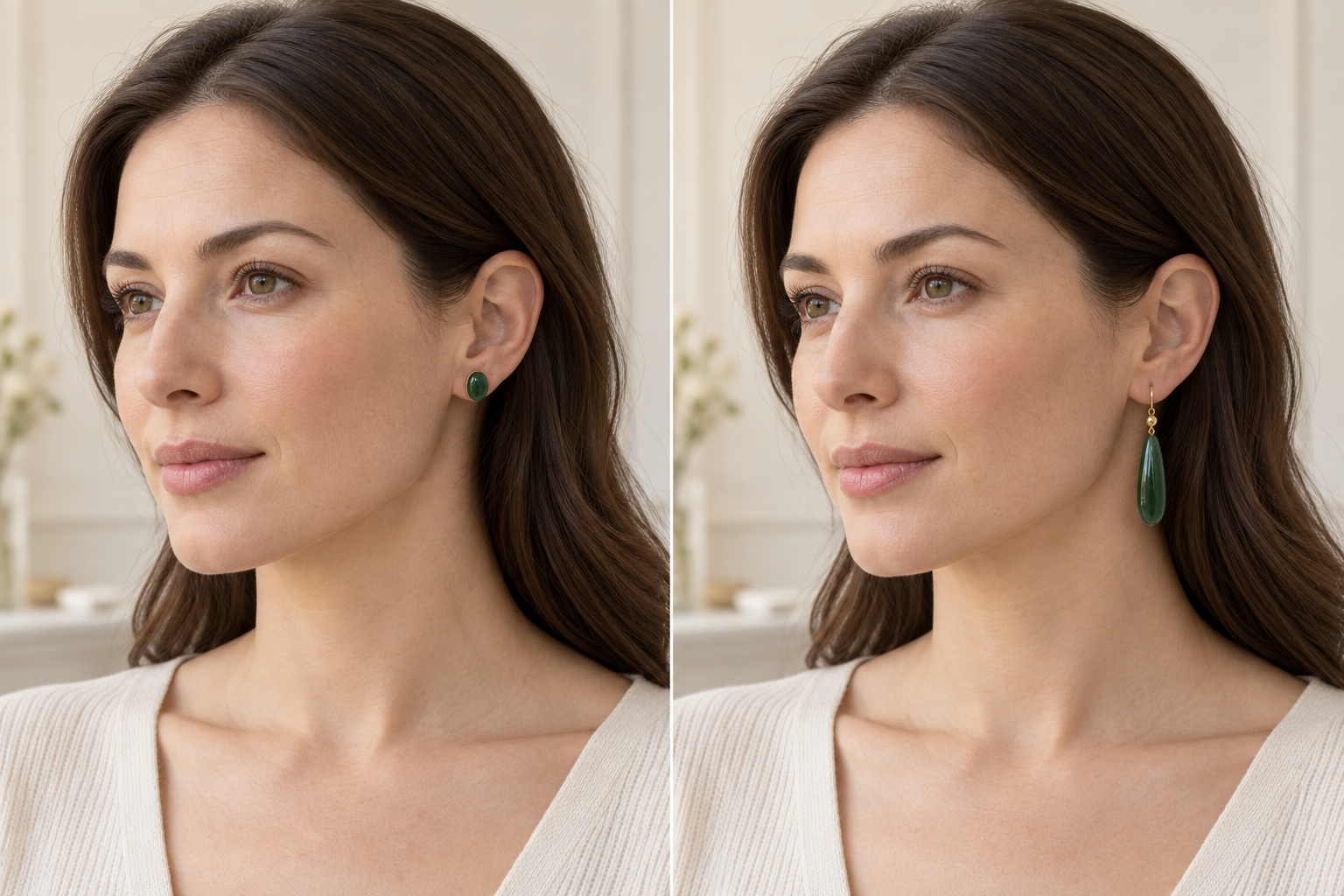
The difference becomes easier to see when everything except the earring stays the same. A stud concentrates color close to the lobe. A drop creates a path that begins at the ear and continues into the space beside the jaw. Neither is automatically more flattering; they simply direct attention differently.
Four measurements matter more than a face-shape label
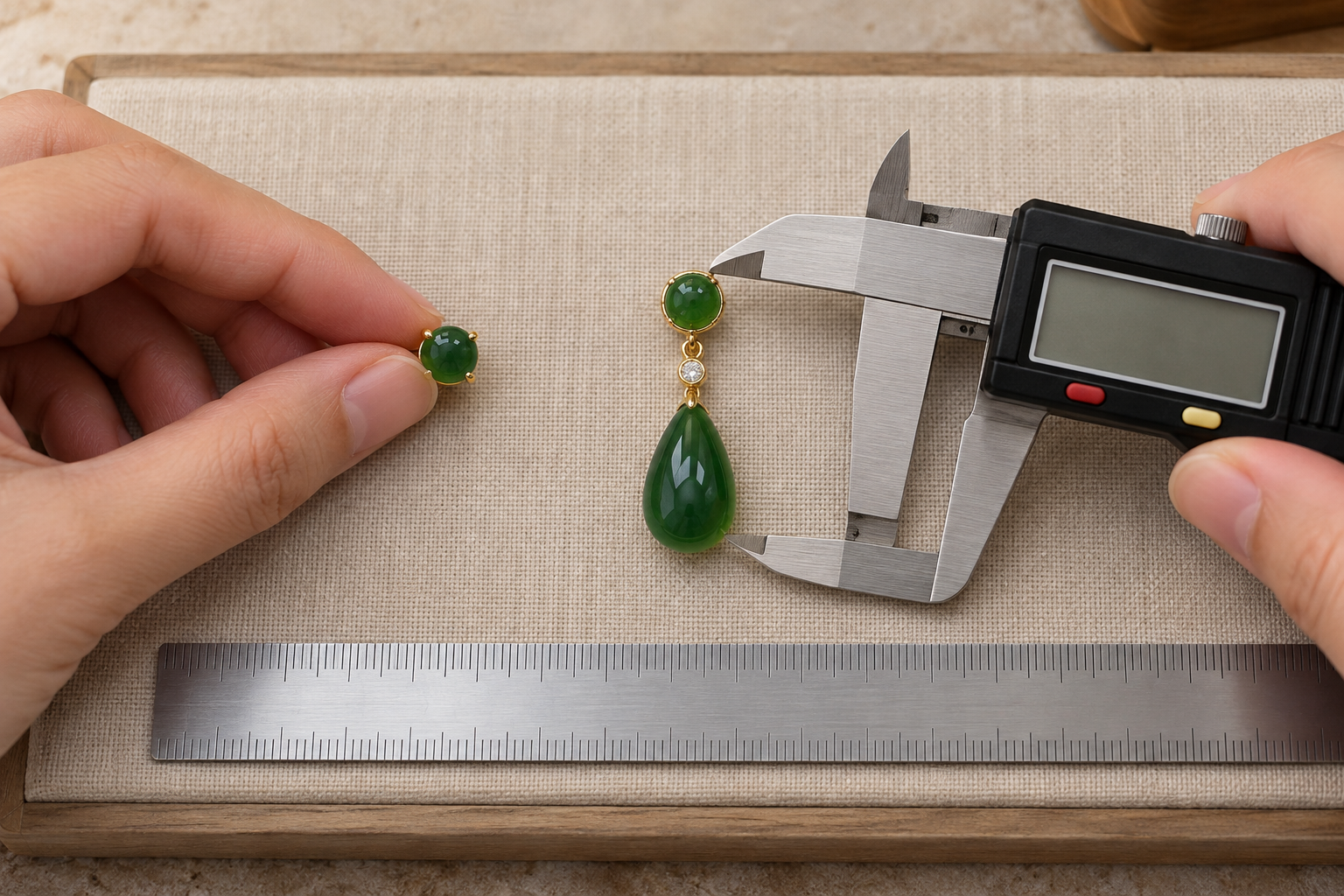
- Visible width. Measure the widest part of the stone or complete design, not only the cabochon. A metal scrollwork frame can make a small jade center read much larger.
- Total drop. Measure from the top of the hook or stud fitting to the lowest point. Product photography can make a 25 mm drop and a 50 mm drop look similar.
- Single-earring weight. A pair weight is less useful for comfort. Ask for the weight of one earring, including its hook, pearl, enamel and metal components.
- Movement zone. Check whether the earring remains above the jaw, ends beside it or moves below it. The same length can sit differently depending on piercing position and neck length.
Hair, glasses and necklines change the result
Hair down
Fine studs can disappear behind thick or dark hair. A polished jade surface, contrasting metal edge or moving lower element improves visibility without requiring a very large stone.
Hair up
More of the jaw and neck is visible, so total drop and movement become stronger. Check the earring from the front and profile—not only in a close crop.
Glasses
Frames already add shape and width around the eyes. Repeat one feature—metal color, curve or visual weight—rather than introducing several competing shapes at once.
High or open necklines
Short drops and studs stay clear of collars. Longer drops gain more breathing room with open necklines, but the clasp and movement still need to feel secure.
Use comfort as a final filter
A flattering outline is irrelevant if the earrings pull, tilt forward or remain in the jewelry box. Jade, pearl, enamel and metal fittings all contribute to weight. Large-looking earrings can be comfortable when they use open construction; small solid beads can feel heavier than expected.
- Look for the weight of one earring rather than the combined pair.
- Check whether the listing identifies the post or hook material and metal finish.
- Use a supportive back for studs with a large front element.
- For drops, check that the hook, leverback or post gives enough security for the movement.
- Stop wearing an earring that causes pain, persistent pulling or skin irritation.
A five-minute try-on test
- Pull your hair back and take one straight-on photo in neutral daylight.
- Take a second photo with your normal hairstyle and glasses, if worn.
- Look at the full head and shoulders rather than zooming only on the ear.
- Check where the earring ends in relation to the cheekbone and jaw.
- Turn your head and watch how a drop moves; movement changes its apparent width.
- Wear the pair for at least ten minutes at home before deciding whether the weight feels suitable.
If the earring looks good only in a close-up product photo, you do not yet know how it works with your face. Ask for dimensions, check a full portrait, and judge comfort separately from appearance.
Match the choice to real jade earring formats
For a compact look, compare oval jade studs and cabochon studs by their complete visible width, including any metal frame. For movement, compare narrow bead drops, disc earrings, pearl-and-jade combinations and asymmetrical designs by total length and the width of the lowest element. Our jade earring buying guide covers material, fittings and comfort in more detail, while the jade earring collection lets you compare stud and drop constructions directly.
Frequently asked questions
What jade earrings suit a round face?
Narrow drops and vertically arranged elements are useful starting points because they create direction beside the cheek. Small discs and rounded forms can also work when their visible width is controlled or they include a lower drop.
What earrings suit a long face?
Studs, oval cabochons, compact clusters and short rounded drops can add width close to the ear. If you prefer long earrings, look for visible width or a curved lower element rather than one extremely thin line.
Are jade studs better for everyday wear?
Studs usually have less movement and are less likely to meet a collar, but comfort still depends on the complete size, single-earring weight, post material and backing. A large solid stud can feel heavier than a light open drop.
How long should jade drop earrings be?
There is no universal ideal. Compare the measured total drop with the distance from your piercing to your jaw and with the necklines you wear. Product listings should provide millimeter dimensions instead of relying only on photographs.
Do face-shape rules matter if I wear glasses?
Glasses add another visible shape around the eyes. Consider the frame width, color and curves together with the earrings. Often the cleanest result comes from repeating one element rather than trying to match everything.
Can asymmetrical jade earrings work with every face shape?
Yes. Asymmetry creates movement and shifts attention, so it can be used intentionally on any face. Compare the visual weight of both sides and make sure the difference looks designed rather than accidental.
Use face shape to choose a direction, not to ban a style. Then verify the earring’s visible width, total drop, single-earring weight, movement and fitting. The pair that works best is the one that creates the emphasis you want and remains comfortable long enough to wear.