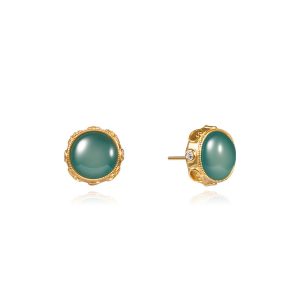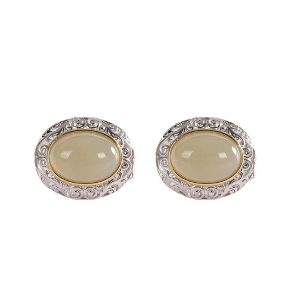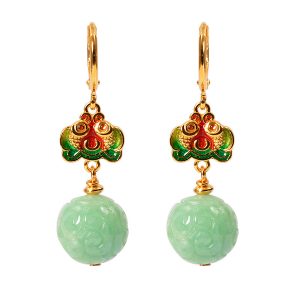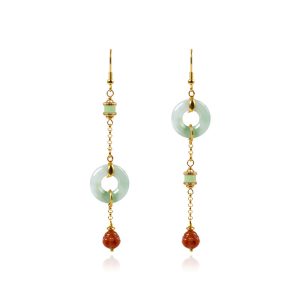
Jadeite and nephrite are both jade, but an earring buyer should not treat the names as a simple “premium versus ordinary” ranking. They are different mineral materials with different average density, hardness, structure and visual character. The better choice depends on the color and finish you prefer, the quality of the matched pair, the setting and the seller’s disclosure—not the word on the label alone.
Choose jadeite earrings when you prefer clearer translucency, sharper internal color contrast or a broader color range. Choose nephrite earrings when you prefer an even, cohesive appearance with a soft, waxy luster. Both are exceptionally tough for gemstones. Neither can be identified reliably from color, a phone flashlight, weight or a product photograph. For a meaningful purchase, compare the finished pair and verify the material and treatment disclosure.
This guide stays with the questions that matter specifically for earrings: what the stones look like at small scale, whether one type is automatically heavier, how to judge a matched pair, what a photograph can reveal and when a laboratory report is the only useful answer.
Jadeite vs nephrite earrings: quick comparison
Swipe sideways to compare all columns →
| What to compare | Jadeite earrings | Nephrite earrings |
|---|---|---|
| Mineral structure | Interlocking pyroxene-group mineral grains | Densely interwoven amphibole-group fibers |
| Typical visual tendency | Can show crisper color boundaries, mottling and stronger translucency | Often looks smoother, more even, creamy or softly translucent |
| Common color impression | Green, blue-green, white, lavender, yellow, orange and black, among others | White, celadon, olive, deep green, gray, yellow, brown and black, among others |
| Mohs hardness | About 6.5–7 | About 6–6.5 |
| Typical specific gravity | About 3.34 | About 2.95 |
| Toughness | Exceptional resistance to breaking and chipping | Exceptional; its fiber network generally gives even higher fracture toughness |
| Useful reason to choose | You prefer its particular color, contrast and translucency | You prefer its even texture, restrained color and softer luster |
These are tendencies, not a home identification test. Opaque jadeite exists, translucent nephrite exists, and polishing, lighting, thickness and treatment can change how either material appears. A seller should state the material instead of expecting the customer to guess it from green color.
What the difference can look like at earring scale
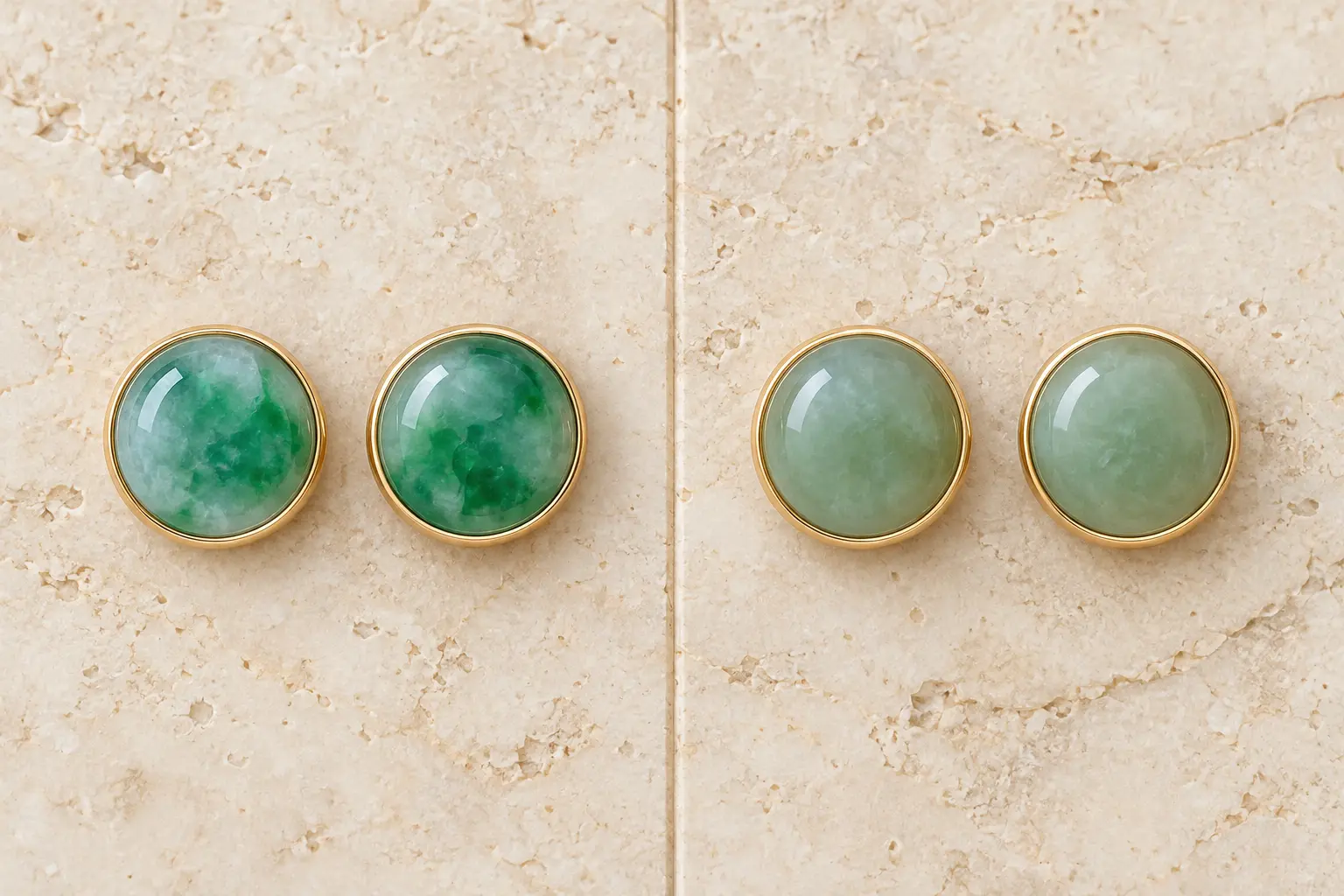
A bangle gives the eye a large continuous surface. Earrings usually show much smaller cabochons, beads or discs, so the distinction may be subtler. On a 10–14 mm stud, pair matching and polish can be more obvious than the mineral family itself.
Jadeite does not have one look
Jadeite may appear glassy and translucent, cloudy and mottled, finely textured or opaque. Fine green material is only one part of its color range. Lavender, white, yellow, orange, black and blue-green jadeite are also encountered in jewelry. Within one pair, color placement and translucency should be compared earring to earring—not only against an idealized catalog photograph.
Nephrite does not simply mean dark green
Nephrite can be white, celadon, olive, gray-green, yellow-brown, deep green or nearly black. Its interwoven structure often gives a polished cabochon a cohesive, softly lustrous appearance. Fine nephrite can be valuable, and pale material is not automatically lower quality.
The internal structure explains more than the color name
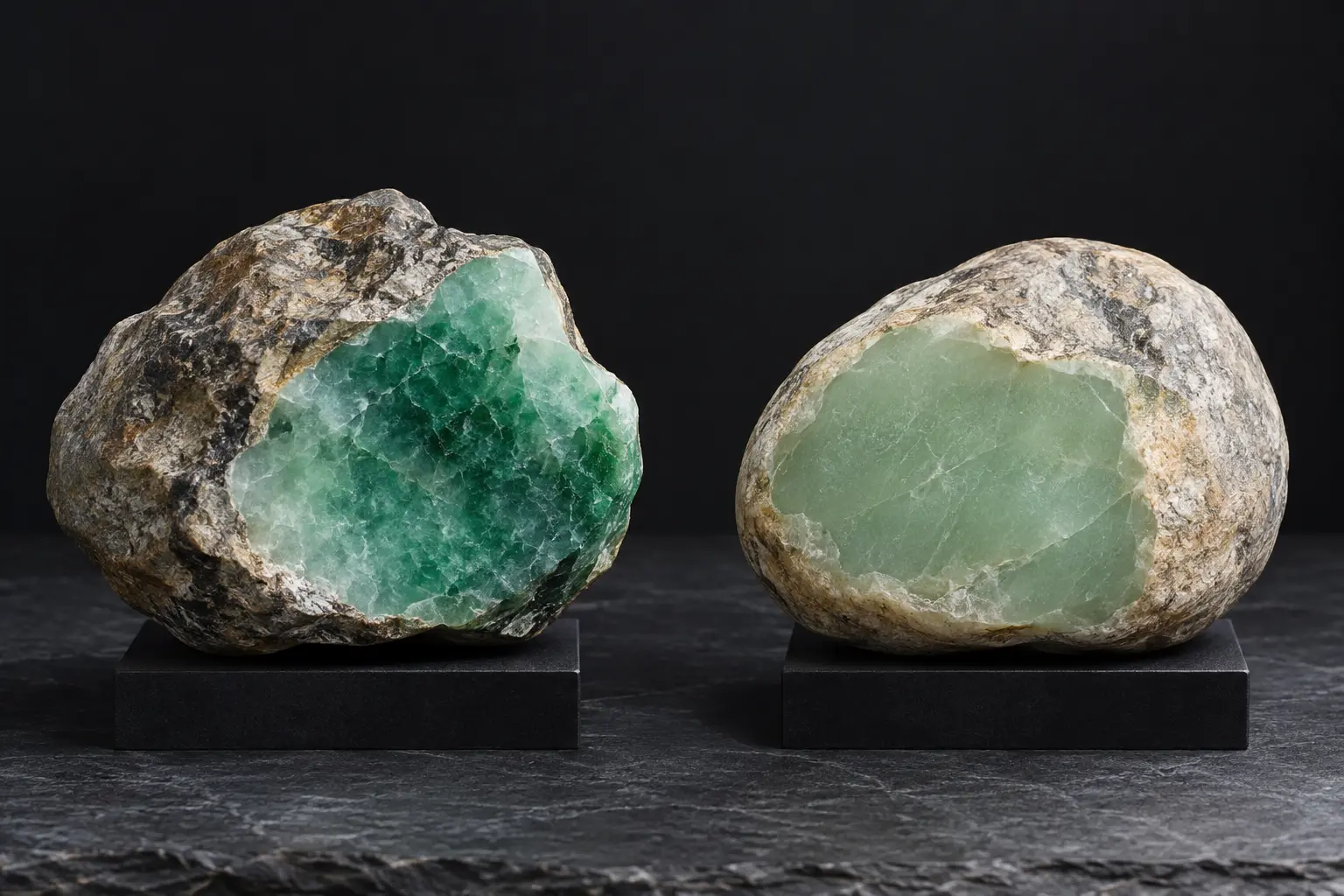
Both materials consist of tiny interlocking crystals, which is why both are unusually tough. Jadeite has a granular interlocking structure. Nephrite has a densely interwoven fiber network. Hardness and toughness are different: hardness describes resistance to scratching, while toughness describes resistance to breaking and chipping.
Is one type heavier on the ear?
Jadeite’s typical specific gravity is about 3.34, compared with about 2.95 for nephrite. If two stones had exactly the same volume, jadeite would be roughly 13% denser. Finished earrings are rarely controlled that neatly.
A 10 mm jadeite cabochon may weigh less than a thicker 14 mm nephrite cabochon. Metal settings, decorative frames, posts, hoops, links and backing systems can outweigh the mineral-density difference. Compare the published pair weight, complete dimensions and fastening instead of predicting comfort from the stone name.
For a symmetrical pair, divide the stated pair weight by two only as a rough per-ear estimate. Do not do this for asymmetrical earrings unless each piece has been weighed separately.
How lighting changes the comparison
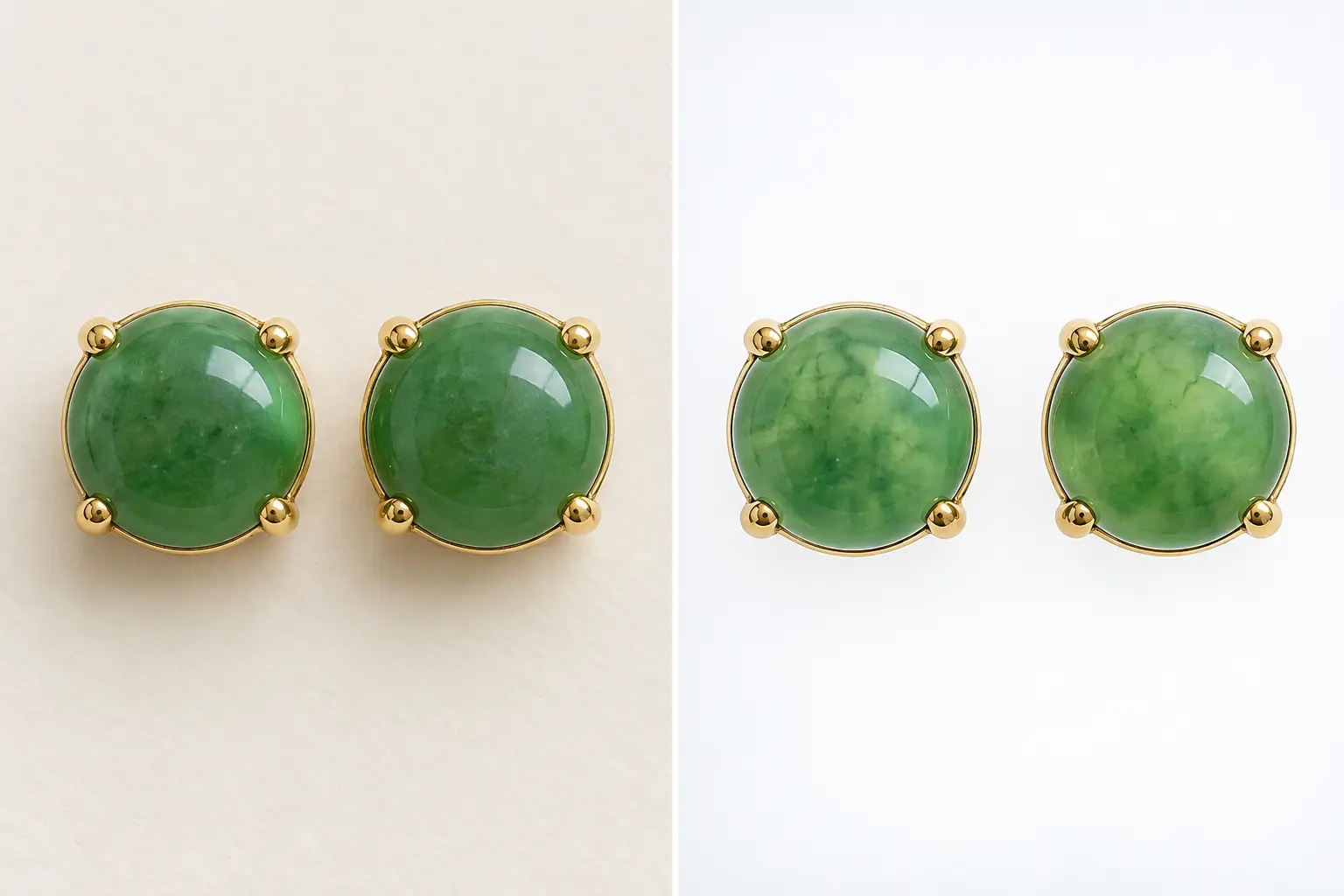
Neutral reflected light helps you compare surface polish, visible color, metal finish and how well the pair matches. Transmitted light can reveal how light passes through the stone and where internal color is concentrated. Neither view proves jadeite, nephrite, geographic origin or treatment.
For earrings, inspect the pair before debating the mineral
Two individually attractive stones can still make a weak pair. Earrings are viewed together, so the buyer should compare both fronts, both side profiles and both backs. This matters for jadeite and nephrite equally.
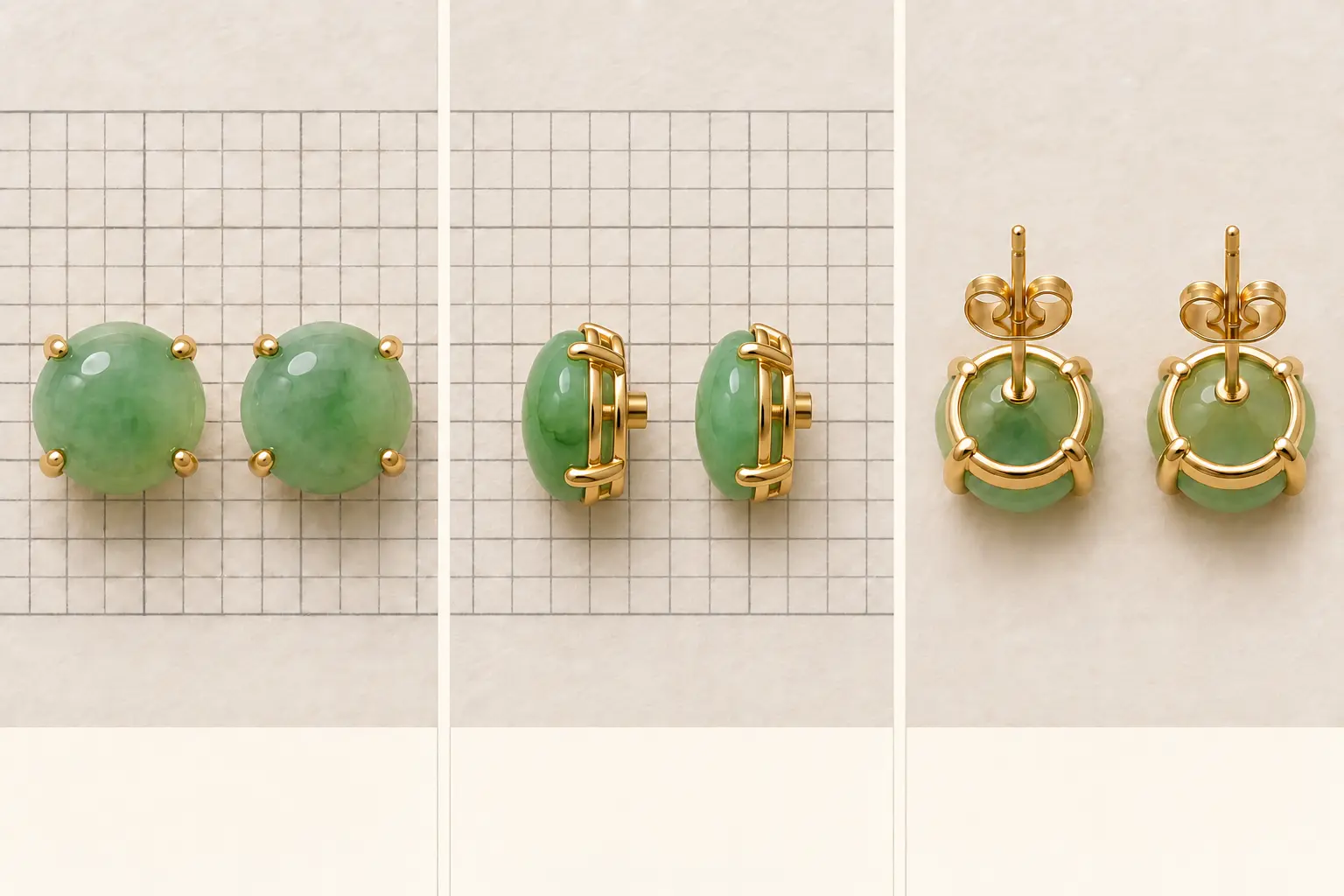
- Compare color distribution across both pieces. Natural variation is possible, but the product page should show the actual pair or explain that the shipped pair will vary.
- Compare complete front size. Measure the metal setting as well as the jade. A 12 mm stone in a wide frame does not wear like a 12 mm unframed bead.
- Check thickness and profile. One higher dome can make a stud tip differently or catch more light than its partner.
- Check posts and backs. Straight posts, balanced settings and appropriate backs affect wear more directly than the jadeite or nephrite label.
- Ask what is being disclosed. Stone identity, treatment, metal, plating, dimensions, pair weight and closure should be separate facts.
Which type works better for studs, drops and discs?
Stud earrings
Judge complete front size, dome height, pair matching and back support. Either jadeite or nephrite can work well. A broad setting may influence comfort more than the mineral.
Drop earrings
Compare total drop, movement, pair weight and how well the two sides balance. Color contrast may remain visible from farther away, but stone identity still needs disclosure.
Discs and hoops
Inspect thickness, drilled edges, symmetry and how metal passes through or around the jade. Thin sections can appear more translucent than thicker pieces of the same material.
Mixed-material designs
Require every visible component to be named. Jadeite or nephrite may be combined with agate, enamel, glass, plated silver or other stones; “jade earrings” should not hide the rest.
Is jadeite always more valuable?
No. Fine translucent jadeite with strong, even color can command very high prices, but that does not make every jadeite earring more valuable than every nephrite earring. Fine nephrite can also be valuable. Size, color, texture, translucency, workmanship, treatment, matched-pair quality and documentation all affect the finished piece.
A low-detail listing that says “premium jadeite” without measurements or treatment information is less useful than a careful nephrite listing that identifies the material, dimensions, pair weight, setting and return terms. The same logic works in reverse.
Treatment and documentation matter more than guessing
Color, sound, cold feel, a scratch test and a phone flashlight are not reliable ways to separate jadeite from nephrite or to determine treatment. Scratch testing can damage the jewelry. Density cannot be judged accurately from a completed earring because stone volume and metal components are unknown.
If mineral identity or treatment materially affects the price, ask for a report from a qualified gemological laboratory. Make sure the report describes the item or pair you are buying and that its identifying details match the jewelry.
“Type A” is a treatment description commonly used for jadeite; it is not a universal quality grade and does not automatically mean fine color, strong translucency, good matching or high workmanship.
How to choose between jadeite and nephrite earrings
- Choose jadeite for a visual preference: you want a particular lavender, blue-green or vivid green color, sharper internal variation or stronger translucency.
- Choose nephrite for a visual preference: you want white, celadon, olive or deep green with an even, cohesive texture and softer luster.
- Do not choose by durability alone: both are exceptionally tough enough for normal earring use, although settings and posts can still bend or break.
- Do not choose by assumed weight: compare complete dimensions and the stated pair weight.
- Do not choose by the word “jade” alone: require a precise material and treatment description when it matters to the purchase.
Use the jade earring size guide to compare fronts, drops and pair weight. The face-shape guide explains how front width and drop direction affect visual balance, while the jade earring buying guide covers closures and everyday wear. For the same mineral comparison in a different jewelry form, read jadeite vs nephrite bracelets. You can also view the current jade earring collection.
Frequently asked questions
Are jadeite and nephrite both real jade?
Yes. Both are materials recognized as jade, although they are different mineral substances with different structures and average physical properties.
Can you tell jadeite from nephrite by color?
No. Their color ranges overlap. Color and visual texture may suggest what to investigate, but they do not establish mineral identity or treatment.
Are jadeite earrings heavier than nephrite earrings?
Jadeite is denser on average, but a finished earring’s weight depends on stone volume, thickness, metal and construction. Compare the stated pair weight rather than the mineral name.
Which is more durable for everyday earrings?
Both are exceptionally tough gemstones. Jadeite is slightly harder on average; nephrite generally has higher fracture toughness. In earrings, posts, links, solder joints and backs may fail before the jade does.
Is nephrite cheaper than jadeite?
There is no reliable material-only rule. Fine jadeite can reach exceptional prices, but fine nephrite can also be valuable. Quality, treatment, workmanship, matching and documentation matter.
Does a flashlight prove that jade earrings are real?
No. Transmitted light can show light passage and internal color distribution, but it cannot by itself prove jadeite, nephrite, natural color or treatment.
What should a jade earring listing disclose?
Look for the specific jade material, treatment information, complete dimensions, pair or per-piece weight, metal and plating, closure, actual-pair photographs and return terms.
Jadeite and nephrite are both legitimate jade choices. Decide by the finished pair: appearance, matching, dimensions, weight, fastening, treatment disclosure and documentation. The mineral name should clarify the purchase—not replace those details.