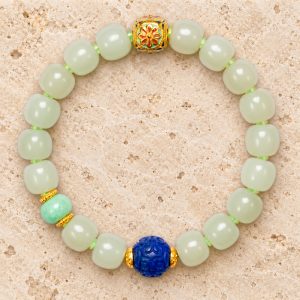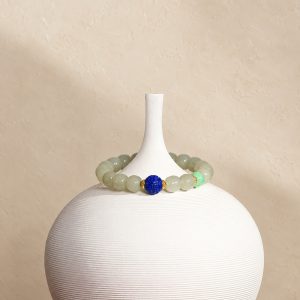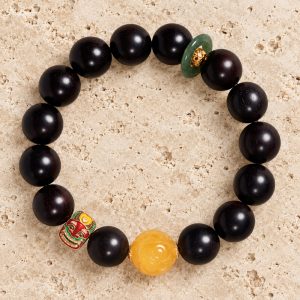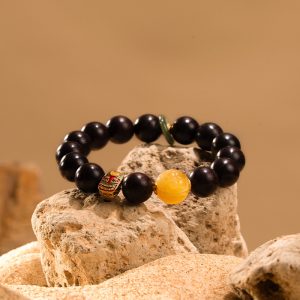
If you are comparing a jadeite vs nephrite bracelet, the useful answer is not that one is “real jade” and the other is not. Both are jade. They are different minerals with different visual character, and either can make a durable bracelet when the material, construction, and fit are properly described.
- Choose jadeite if you like clearer translucency, stronger color contrast, or colors such as blue-green and lavender.
- Choose nephrite if you prefer an even, smooth-looking surface and softer white, celadon, or deep-green tones.
- Both are exceptionally tough for gemstones, although both can still be scratched or damaged by a hard impact.
- The stone name alone does not determine quality or price. Treatment disclosure, color, texture, bead matching, construction, and documentation all matter.
For most bracelet buyers, the decision becomes easier when you compare finished pieces instead of loose stones. Bead diameter, bracelet weight, clasp type, and wrist range often affect daily comfort more than the mineral name.
Jadeite vs nephrite bracelet: quick comparison
| What to compare | Jadeite | Nephrite |
|---|---|---|
| Mineral family | Pyroxene-group mineral | Amphibole-group material with a fine interlocking structure |
| Typical visual character | Can show stronger color contrast and greater translucency | Often appears smooth, even, creamy, or softly translucent |
| Color range | Green, white, lavender, yellow, orange, black, and blue-green varieties | White, celadon, light-to-dark green, gray, yellow, brown, and black |
| Mohs hardness | About 6.5–7 | About 6–6.5 |
| Toughness | Exceptional resistance to breaking and chipping | Exceptional toughness; its interlocking structure is especially resistant to breakage |
| Market positioning | Fine translucent, evenly colored jadeite can reach very high values | Fine nephrite can also be valuable, especially material with desirable color, texture, and documented origin |
| Best reason to choose it | You prefer its color, translucency, and visual contrast | You prefer its soft luster, even texture, and restrained color |
Both are jade, but they are not the same mineral
The word jade is an umbrella name. The Gemological Institute of America explains that modern gemologists use it for nephrite, jadeite, and, under certain conditions, green omphacite. In everyday jewelry shopping, the comparison buyers most often encounter is jadeite versus nephrite.
This matters because a listing that says only “jade bracelet” leaves an important question unanswered. A useful product page should identify the stone more precisely and should separately name any other materials, such as agate, amber, lapis lazuli, enamel, or plated silver.
It does not mean every bracelet needs a geology lesson. It means the seller should give you enough information to understand what you are buying.
What difference will you actually see?
Jadeite often shows more visual contrast
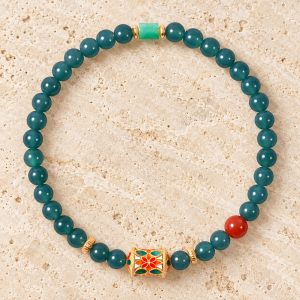
Jadeite can appear bright and glassy, softly translucent, mottled, cloudy, or nearly opaque. It also occurs in a broad range of colors. A blue-green jadeite strand, for example, can look cooler and more transparent than an opaque green nephrite strand, even when both are polished into round beads.
Nephrite often looks softer and more even
Nephrite is commonly associated with white, celadon, olive, and deeper green tones. Its fine interlocking structure can give a finished bead a smooth, cohesive appearance. Some buyers describe this as creamy or waxy, but the exact look still depends on polish, color, texture, and lighting.
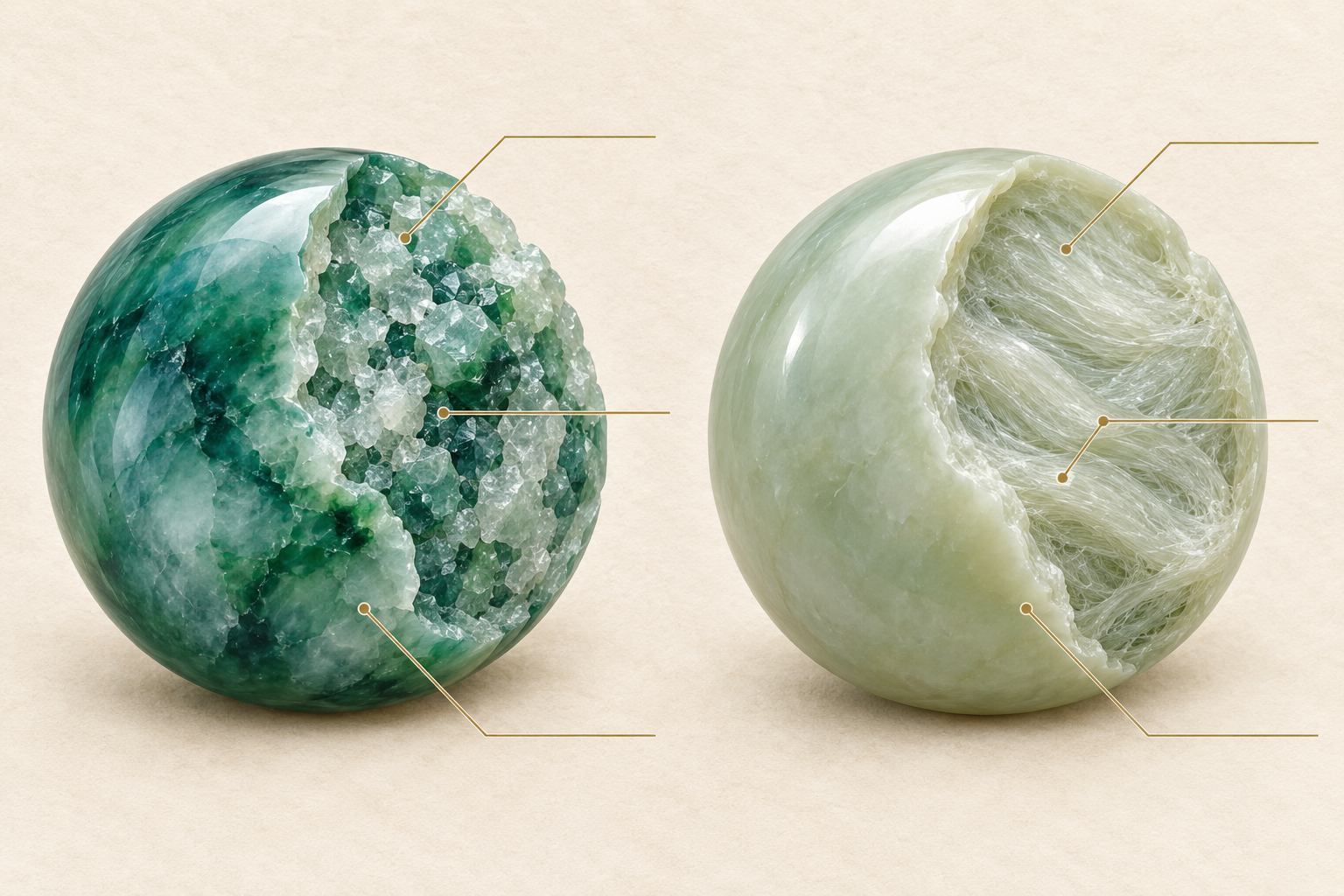
Jadeite
Nephrite
Interlocking grains
Crisp internal contrast
Glassy luster
Interwoven fibers
Dense fiber network
Soft, waxy luster
Both materials are real jade. The difference starts inside the stone: jadeite is a mosaic of interlocking mineral grains, while nephrite is built from densely interwoven mineral fibers.
Granular pyroxene crystals
- Often shows stronger color boundaries or mottling.
- Fine material can look more translucent or glassy.
- Mohs hardness: approximately 6.5–7.
Interwoven amphibole fibers
- Often has a smoother, more even visual texture.
- Commonly shows a soft, waxy luster.
- Mohs hardness: approximately 6–6.5.
Important: hardness measures scratch resistance, not resistance to breaking. Nephrite’s fibrous structure gives it exceptional toughness. This is a simplified teaching illustration—not a microscope image and not an authenticity test.
How to read bracelet photos like a buyer
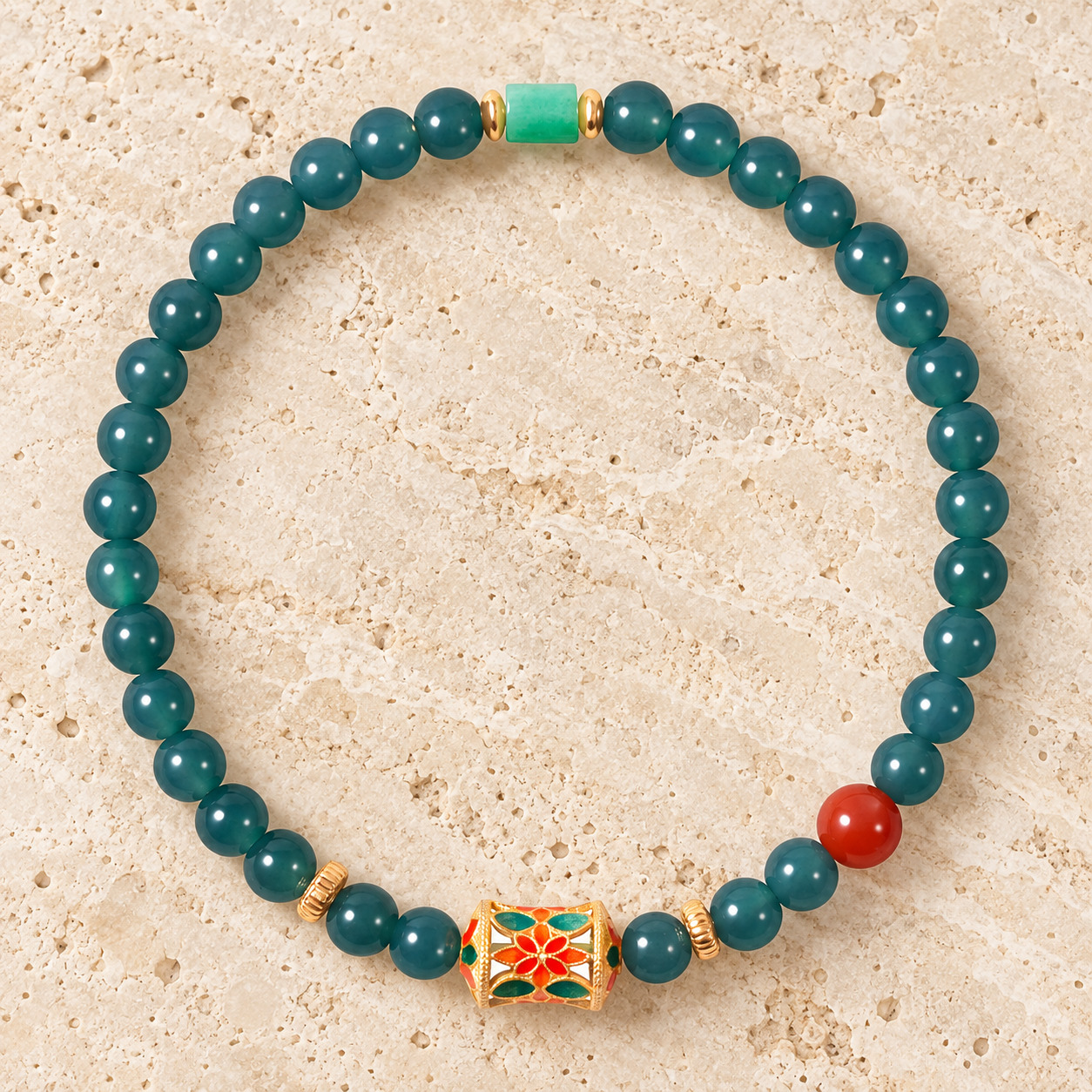
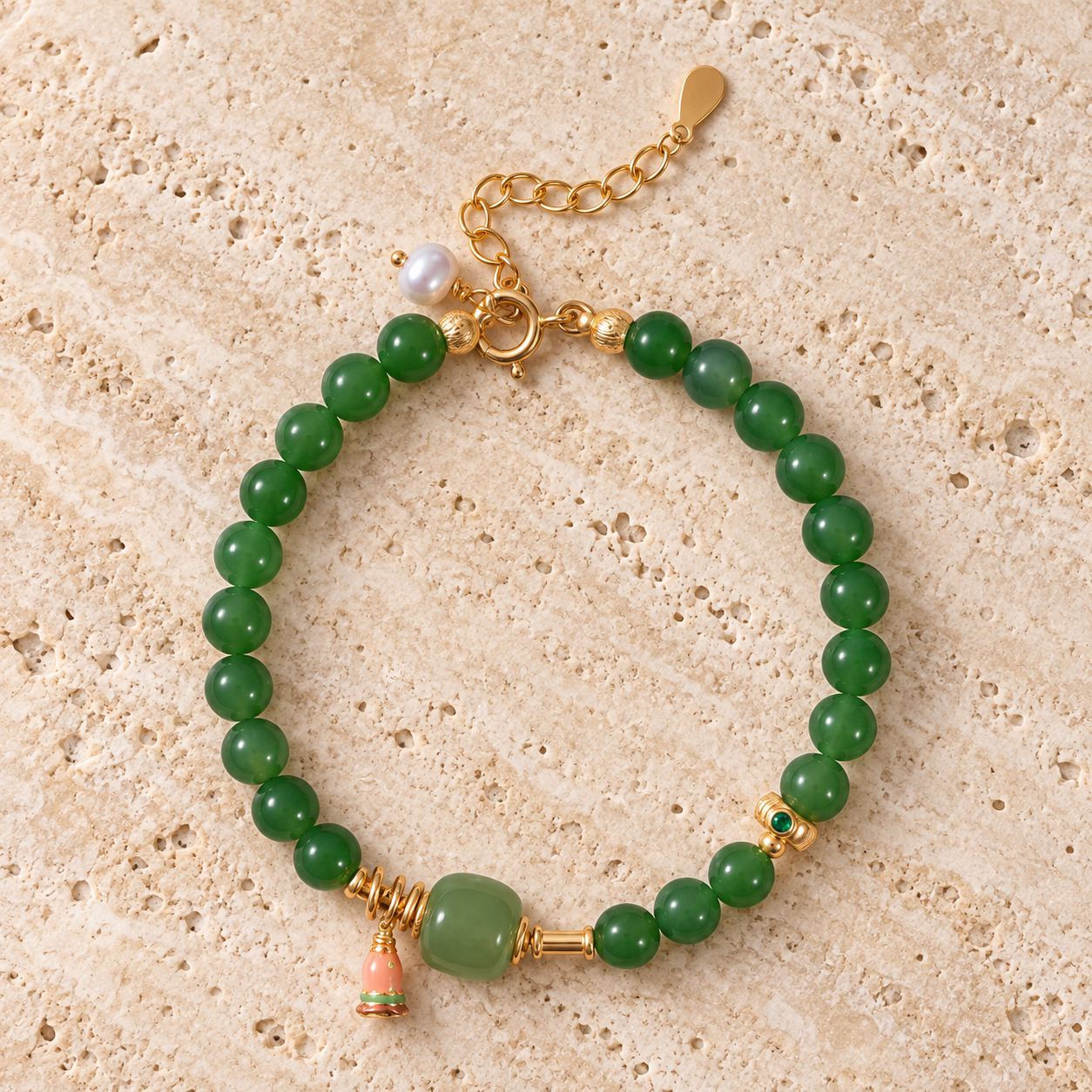
A useful bracelet image should do more than show color. It should let you check bead size, material changes, construction, and whether the description matches what is visible. The following diagrams use real product close-ups rather than simulated stone textures.
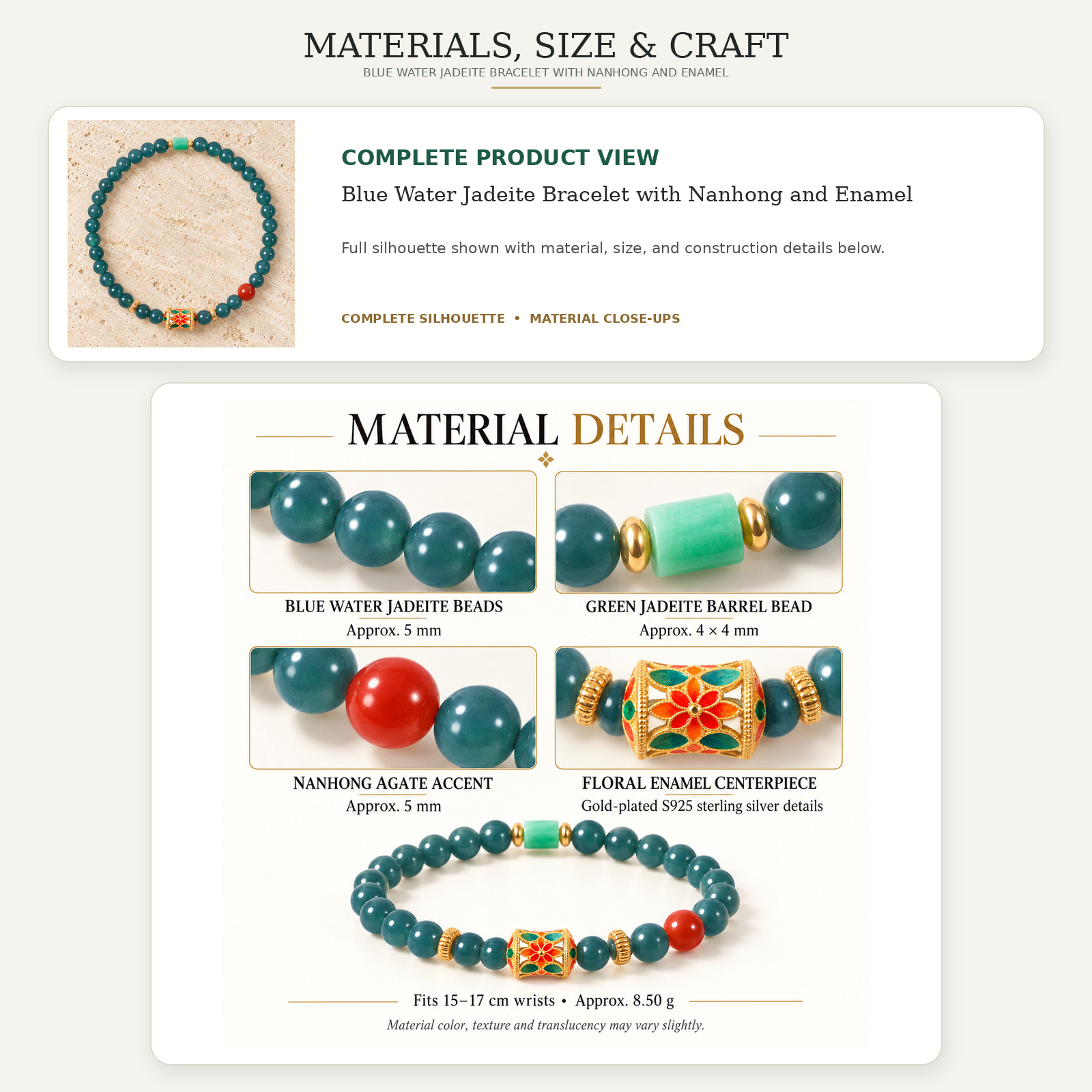
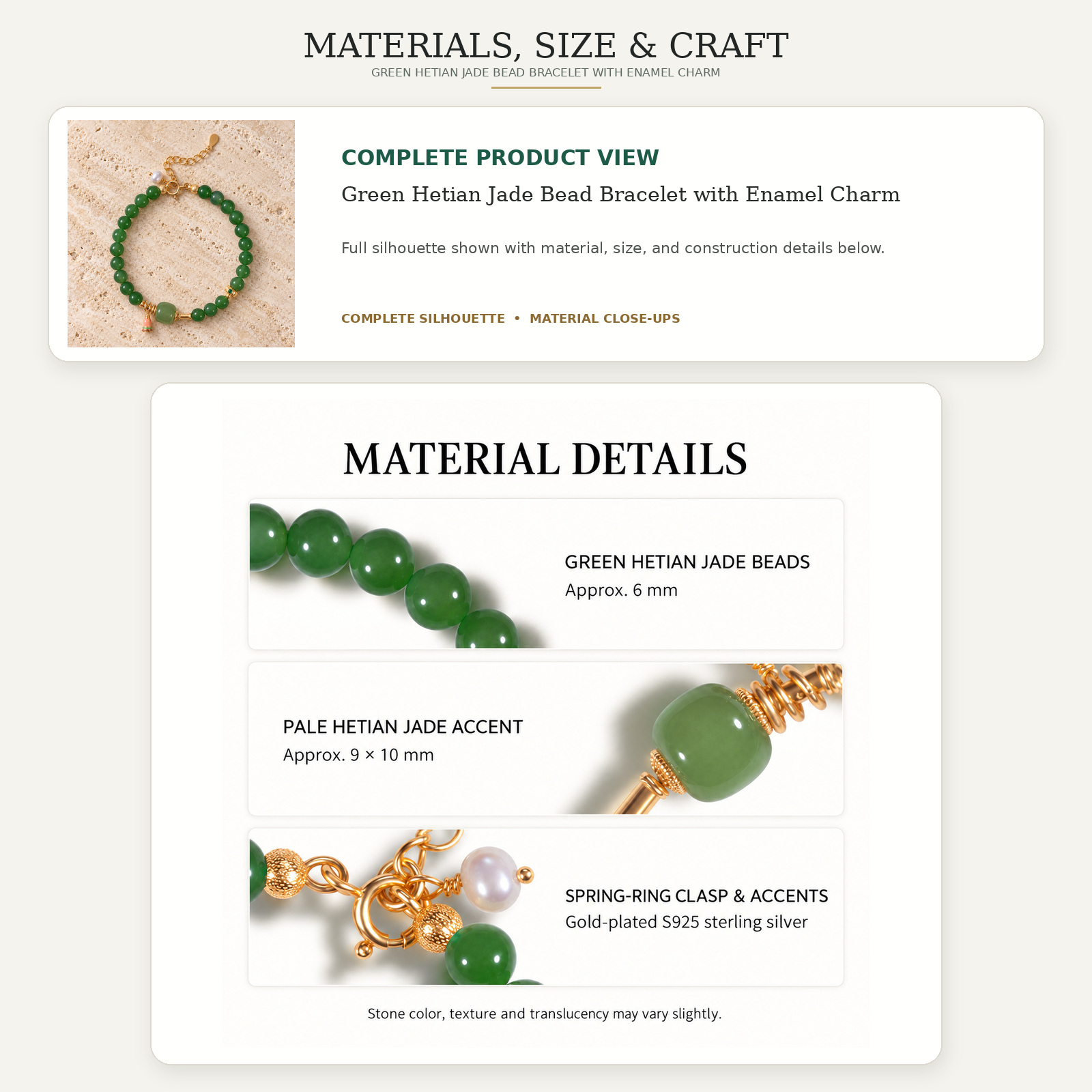
Color distributionCompare several beads, not the brightest single bead. Natural variation can occur, but the seller should not hide it with heavy filters.
Light and translucencyLook for neutral daylight or soft white light. A backlit image can show light transmission, but it is not an authenticity test.
Surface and drill holesZoom in for chips, flat spots, polish quality, and wear around drilled holes. These are construction clues, not mineral tests.
Every visible componentThe listing should name accent stones, plated or solid metal, enamel, cord, clasp, and focal beads separately.
These three products are useful visual examples, but they are not a controlled mineral test. Their weights differ because their bead dimensions, number of beads, metal components, focal stones, and construction are different. You should not identify jadeite or nephrite by weighing a finished bracelet.
How does each type feel on the wrist?
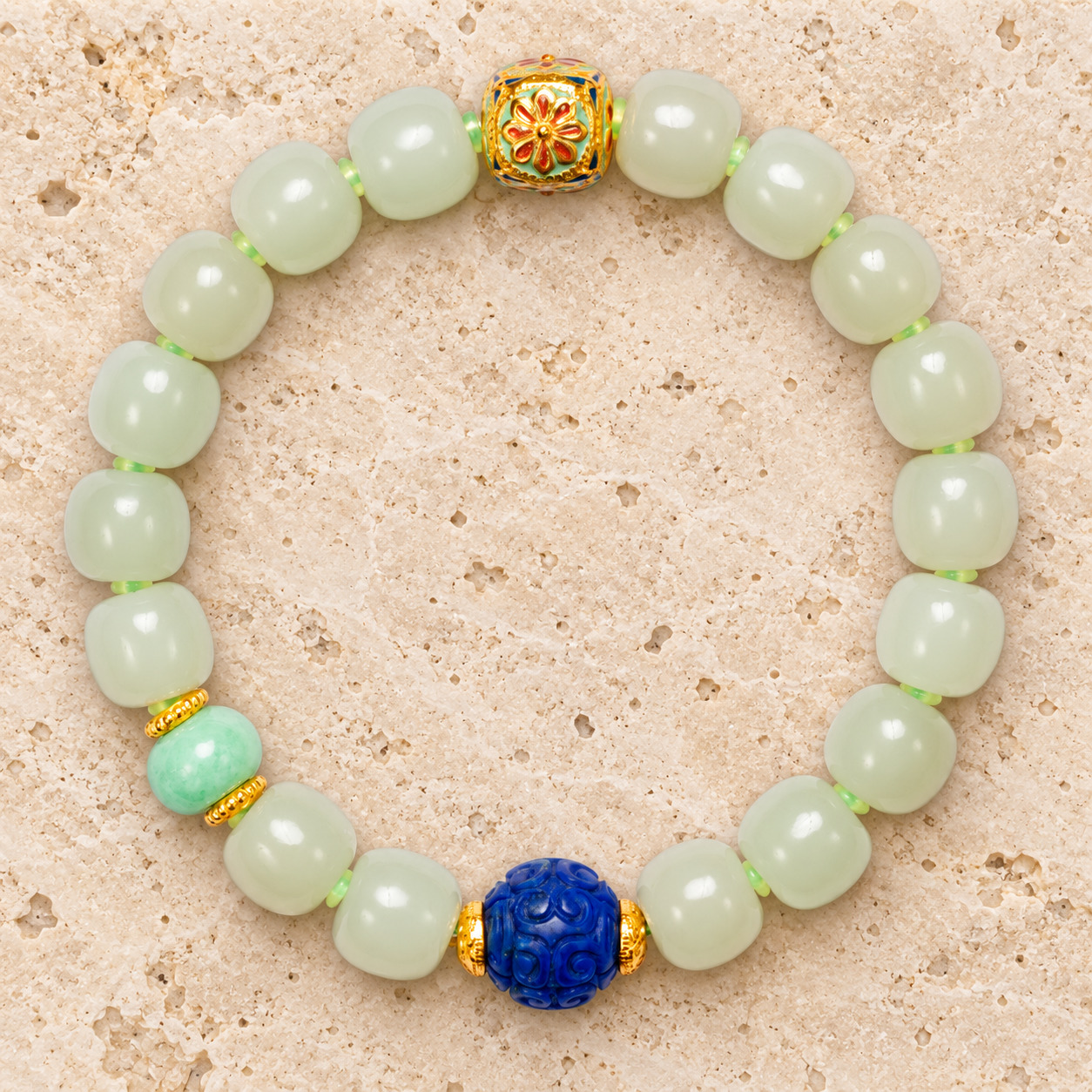
There is no single “jadeite feel” or “nephrite feel.” A slim 5 mm jadeite strand can feel light and unobtrusive. A 9 × 10 mm nephrite strand can feel substantial. Reverse the sizes and the experience changes again.

A bracelet can fit the same wrist circumference and still feel very different. Bead diameter changes how far the bracelet projects from the skin, while the complete bracelet weight changes how much it moves during wear.
5 mm round bead
Complete bracelet: 8.50 g
Wear feel: light and discreet
6 mm round bead
Complete bracelet: 13 g
Wear feel: more present, still compact
9 × 10 mm oval bead
Complete bracelet: 34.92 g
Wear feel: substantial and more mobile
The illustration compares relative projection and is not life-size on every screen. Listed weights are for the complete example bracelets—including cord, metal fittings and accent stones—not the weight of a single jade bead.
For daily comfort, check these specifications before focusing on the stone name:
- Bead diameter: larger beads sit farther from the wrist and occupy more inside space.
- Total weight: 8.50 g and 34.92 g can both fit the same wrist range but will not feel remotely alike.
- Construction: elastic is quick to put on; a clasp and extension chain gives more control over finished length.
- Surface details: enamel charms, metal spacers, carved focal beads, and dangling parts may catch more easily than a plain strand.
- Wrist range: use the maker’s stated fit instead of assuming that every bracelet with the same number of beads fits the same way.
If fit is your main concern, use the measurements in our bracelet size guide before choosing between materials.
Durability: hardness and toughness are not the same thing
This is where many jade comparisons become misleading. Hardness describes resistance to scratching. Toughness describes resistance to breaking and chipping. A stone can be difficult to break without being impossible to scratch.
GIA lists jadeite at about 6.5–7 and nephrite at about 6–6.5 on the Mohs hardness scale. Its jade buyer’s guide also notes that both have exceptional toughness and resist breaking and chipping very well.
For a normal bracelet buyer, that means either material can suit regular wear. It does not mean you should wear it through every activity. Remove a jade bracelet before weight training, contact sports, heavy housework, or any task where it may strike metal, tile, stone, or machinery. Keep it away from harsh cleaners, and store it so metal parts from other jewelry do not rub against the polished surface.
Is jadeite always more valuable than nephrite?
No. Fine jadeite occupies the highest end of the jade market, but the word jadeite does not automatically make a bracelet valuable. Low-quality, heavily treated, poorly matched, or vaguely described jadeite is not made exceptional by its mineral name.
For jadeite, GIA identifies color, transparency, and texture as the three most important quality factors. In a beaded bracelet, matching also matters: buyers usually pay attention to whether the beads work together in color, translucency, diameter, polish, and overall appearance.
Nephrite has its own high-quality and collectible material. Color, fineness of texture, carving or bead workmanship, matching, condition, and documented origin can all influence price. A well-made nephrite bracelet can be more desirable than an ordinary jadeite bracelet.
Treatment can matter more than the jadeite or nephrite label
Two bracelets can both be described as jadeite yet differ greatly in treatment, durability considerations, and value. In the jadeite trade, the A, B, and C labels describe treatment—not beauty, rarity, or an overall quality grade.
| Trade label | What it generally means | What the buyer should know |
|---|---|---|
| A jade | Natural jadeite, or jadeite polished with wax only | “A” does not automatically mean fine color, texture, or workmanship. |
| B jade | Acid-bleached and then impregnated with polymer resin | The treatment should be disclosed and may affect long-term care and value. |
| C jade | Dyed material | Color appearance alone cannot reliably reveal the dye. |
| B + C | Bleaching/impregnation combined with dyeing | Ask for a clear written disclosure; use an independent report for a significant purchase. |
Is Hetian jade nephrite?
Traditionally, Hetian jade refers to nephrite associated with the Hetian jade tradition and deposits of the Kunlun region. GIA’s research on the nephrite jade market describes traditionally named Hetian jade as nephrite, commonly in white, light greenish white, or light green material.
In modern retail, however, geographic names and trade terms are not substitutes for laboratory origin testing. A color photograph cannot prove that a nephrite bead came from a particular deposit. If geographic origin is part of the price, ask what report supports that statement.
For ordinary style selection, it is still useful to understand that a bracelet described as Hetian jade belongs on the nephrite side of a jadeite versus nephrite comparison.
The bracelet form changes what you should inspect
The jade type is only one part of the decision. A solid bangle, an elastic bead strand, and a clasped mixed-material bracelet fail in different ways and require different measurements.
Solid bangle
- Inner diameter, not wrist circumference alone
- Band width and thickness
- Cracks, chips, flat spots, and polish
- Usually cannot be resized
Elastic bead strand
- Bead diameter and total weight
- Drill-hole condition and bead matching
- Elastic tension, knot placement, and restringing
- Finished wrist range
Clasped or mixed bracelet
- Finished length and extension range
- Clasp operation and metal disclosure
- Identity of every accent stone
- Edges or charms that may catch
For a bangle, the opening must pass over the widest part of the hand; for a bead bracelet, the finished inner circumference and bead size determine comfort. Do not apply a bangle-size chart to an elastic strand without checking how the seller defines the measurement.
Which one should you choose?
Choose jadeite if you want:
- stronger color contrast or greater translucency;
- blue-green, lavender, vivid green, or multicolor options;
- a smaller jade accent mixed with amber, sandalwood, enamel, or other stones;
- the possibility of a fine, lightweight bead strand.
Choose nephrite if you want:
- a smooth, cohesive, softly polished appearance;
- white, celadon, olive, or restrained deep-green tones;
- a substantial strand built from larger beads;
- the visual tradition associated with Hetian-style jade jewelry.
These are preferences, not rules. Jadeite can be opaque and understated; nephrite can show strong color. The best choice is the bracelet whose photographs, measurements, construction, and material description match the way you actually plan to wear it.
What should you check before buying either one?
- The exact material name. Look for jadeite or nephrite rather than only “jade,” and check the identity of accent beads separately.
- Treatment disclosure. Do not assume that color or price proves untreated material. If treatment status matters, request appropriate documentation.
- Actual measurements. Check bead diameter, focal-bead dimensions, finished wrist range, and total weight.
- Construction. Elastic, clasped, adjustable, double-layer, and wrap bracelets behave differently on the wrist.
- Photos in useful lighting. Look for close, neutral images that show color distribution, polish, texture, bead holes, and metal components—not only a heavily styled photograph.
- What the price claim is based on. A premium should be supported by material quality, workmanship, matching, documentation, or design—not a vague use of the word jade.
Four common misunderstandings
“Only green jade is real.”
False. Both jadeite and nephrite occur in more than one color. Color alone cannot establish identity.
“Jadeite is always better.”
False. Jadeite and nephrite offer different appearances, and quality varies enormously within both categories.
“A scratch test will tell me if it is real.”
Do not scratch finished jewelry. A destructive home test can damage the polish and still fail to identify treatment or a convincing imitation.
“A product photo proves the jade type.”
No. Good photographs help you judge appearance and workmanship, but gemological identity and treatment may require trained testing and laboratory instruments.
Frequently asked questions
Which is better for a bracelet, jadeite or nephrite?
Neither is universally better. Choose jadeite for its color range and potential translucency, or nephrite for its smooth, cohesive appearance and traditional Hetian associations. Then compare the bracelet’s measurements, construction, treatment disclosure, and documentation.
Is nephrite strong enough for everyday wear?
Yes. Nephrite is exceptionally tough and well suited to jewelry, but its polished surface can still be scratched. Remove it for activities where the bracelet may receive a hard impact.
Does jadeite scratch less easily than nephrite?
Jadeite is slightly higher on the Mohs hardness scale, but neither material is scratch-proof. Storage and daily habits matter more than the small numerical difference.
Can jadeite and nephrite be worn together?
Yes. They can appear in one bracelet or be stacked if the designs do not knock or grind against each other. Pay attention to metal edges, heavy charms, and bead movement rather than worrying about mixing the two jade types.
Can I identify jadeite or nephrite from color?
No. Color can guide style selection but cannot reliably identify the mineral or disclose treatment. Similar-looking natural stones, treated materials, glass, and other imitations exist.
Is Hetian jade the same as jadeite?
No. Traditionally named Hetian jade is nephrite, not jadeite. A claimed geographic origin should still be supported by appropriate documentation when it affects the price.
Does “A jade” mean the bracelet is top quality?
No. In the common jadeite treatment system, A jade means natural material or wax-only polishing. It does not grade color, translucency, texture, matching, workmanship, or condition.
What matters most when buying a solid jade bangle?
Check the inner diameter, band width and thickness, cracks or chips, treatment disclosure, and any laboratory documentation. A bangle that cannot pass over your hand is not made wearable by choosing a different jade type.
Which type feels lighter?
You cannot answer that from the jade name alone. Bead size, number of beads, metal parts, accent stones, and construction determine the finished bracelet’s weight and wrist presence.
The bottom line
A jadeite vs nephrite bracelet decision should begin with what you can verify: the stated material, treatment disclosure, bead measurements, total weight, construction, photographs, and supporting documentation. Jadeite may offer stronger color and translucency; nephrite may offer a softer, more even appearance. Both can be durable, attractive choices.
Browse the LuckJade jade bracelet collection to compare current designs and measurements. For help with fit, use the bracelet size guide. For a broader overview of color and construction, read How to Choose a Jade Bracelet.
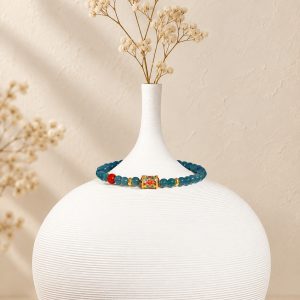
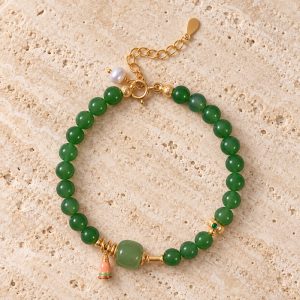
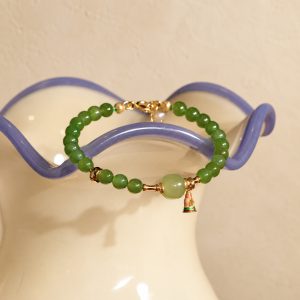
Compare jadeite and nephrite bracelet styles
These four designs show how jade type, bead diameter, construction, and mixed materials change the finished look and feel.